Environmental measurements
Traffic noise measurements
Traffic noise is one of the most common and most noticeable environmental problems in the surroundings of buildings. Roads, railway and tram lines can significantly affect quality of life, the feasibility of new development, as well as the conditions for using existing facilities.
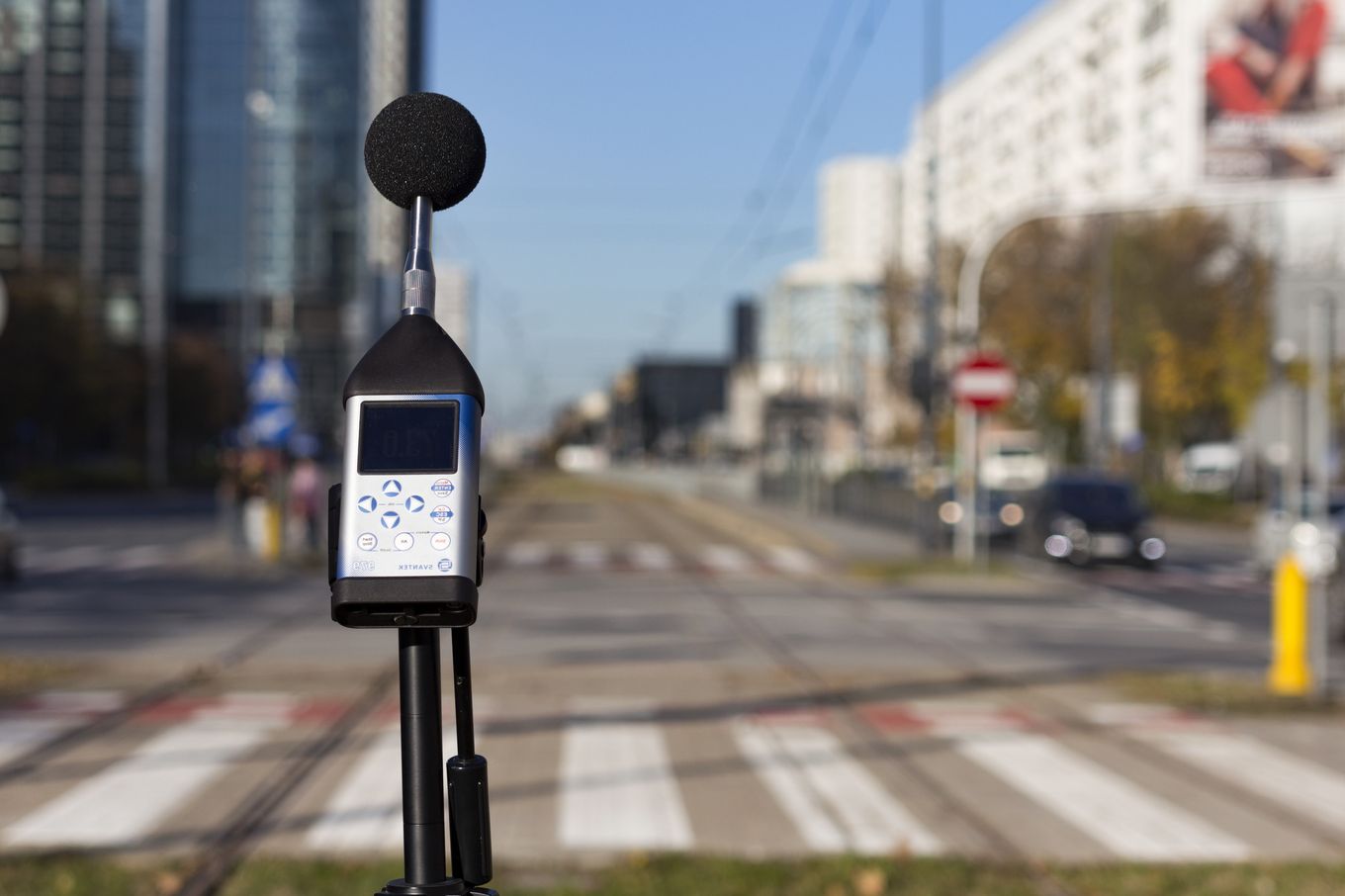
In practice, the issue is not only whether it is “loud” in a given place, but whether the level of acoustic impact remains compliant with the requirements for a specific area and its function. The rules for determining permissible noise levels in the environment result from the Environmental Protection Law, while the types of protected areas and noise assessment indicators are defined by executive regulations to this act.
Traffic noise measurements make it possible to precisely determine the impact of road, rail, and tram traffic on planned or existing development.
This is a study that turns a general sense of nuisance into objective engineering and formal data. Thanks to it, it is possible to assess whether an area is suitable for a specific function, whether acoustic protections are necessary, and whether an investment meets environmental requirements at the stages of design, approvals, and acceptance. The legal basis for protecting areas against traffic noise and the obligation to include these issues in spatial planning results directly from the Environmental Protection Law.
What are traffic noise measurements?
These are specialized environmental studies used to determine the level of noise generated by means of transport and transport infrastructure. They primarily cover the impact of roads, railway lines, and tram lines on areas subject to acoustic protection, such as residential development, hospitals, facilities related to the permanent or temporary stay of children and youth, recreational or spa areas. Such area categories and the corresponding noise assessment indicators are indicated in the Environmental Protection Law, and detailed permissible levels are specified by the regulation on permissible environmental noise levels.
In practice, we analyze not only the sound level itself, but above all its relation to the actual function of the area and formal requirements. This is particularly important for residential, service, and public investments, because even an attractive location may require additional design measures if it is within the range of traffic noise impact. Protection against noise originating from roads, railway lines, and tram lines is explicitly provided for in environmental protection regulations, which indicate, among others, the use of acoustic protections and technical solutions limiting noise propagation.
What exactly do we examine?
We analyze traffic noise wherever it comes into contact with planned or existing development. This includes the impact of road, rail, and tram traffic on investment plots, buildings already in use, and areas covered by acoustic protection. Depending on the purpose of the study, we verify noise levels for daytime and nighttime, assess compliance with requirements for a given type of area, and check whether it is necessary to use screens, partitions, appropriate facade solutions, or other protective measures. Indicators used for assessment, including LDWN, LN, LAeq D and LAeq N, are explicitly indicated in the Environmental Protection Law.
In practice, such measurements are important both for new investments and for existing facilities that have come under increasing influence of transport infrastructure. Data from environmental monitoring show that traffic noise remains one of the main acoustic problems in the surroundings of residential and service development.
Why is this so important?
Traffic noise measurements are most often performed at two key moments.
Planning and acceptance stage
When you want to confirm that planned or existing development meets environmental and acoustic requirements. Such studies are needed, among others, when analyzing land development possibilities, for design documentation, in administrative proceedings, and wherever it is necessary to demonstrate that traffic impact does not exceed permissible levels for a protected area. The noise protection system in Poland is based precisely on the relationship between the noise source and the function of the protected area.
Problem solving
When residents’ complaints appear, investor doubts arise, or there is a need for an objective assessment of the impact of a road, track, or tram line on a building or plot. Then the measurement allows for a reliable assessment of the situation and indicates whether specific acoustic protections, a change of design assumptions, or additional protective measures are needed. The Environmental Protection Law explicitly provides for technical means of limiting the impact of traffic noise, including acoustic protections.
Methodology and reporting
In environmental matters, there is no room for randomness. We conduct measurements in accordance with applicable legal and methodological requirements for environmental noise. In the Polish legal system, there are reference methodologies for carrying out periodic measurements of noise levels for roads, railway lines, and tram lines, and measurement requirements have been regulated in executive regulations to the Environmental Protection Law.
We take into account the specifics of the location, the type of source, the nature of traffic, the function of the protected area, and the purpose of the study. Thanks to this, the report is not merely a set of measurement results, but a tool for making design, environmental, and formal decisions.
In the final study, we present the results, their interpretation, a compliance assessment, and—where needed—recommendations for further noise reduction measures, such as screens, organizational changes, or construction solutions. In practice, this is precisely the type of documentation that forms the basis for further approvals, design analyses, and corrective actions.
Start with a reliable assessment
Do not guess how strongly a road, railway, or tram affects your investment or existing building. Carry out traffic noise measurements and base decisions on objective data. You will receive a clear diagnosis, a report, and concrete grounds for further design, formal, and protective actions.
Traffic noise measurements
Schedule traffic noise measurements and check whether your investment or property is properly protected against the impact of transport.


Office / Showroom
Production / Warehouse
Let's do something together
Use the form - we will respond as soon as possible!