Acoustic measurements
Measurements of employee noise exposure level
Occupational hearing damage is one of the most frequently certified occupational diseases in Poland. An employer who, during an inspection or court proceedings, cannot document that their staff’s exposure was within permissible limits bears full financial and criminal liability.
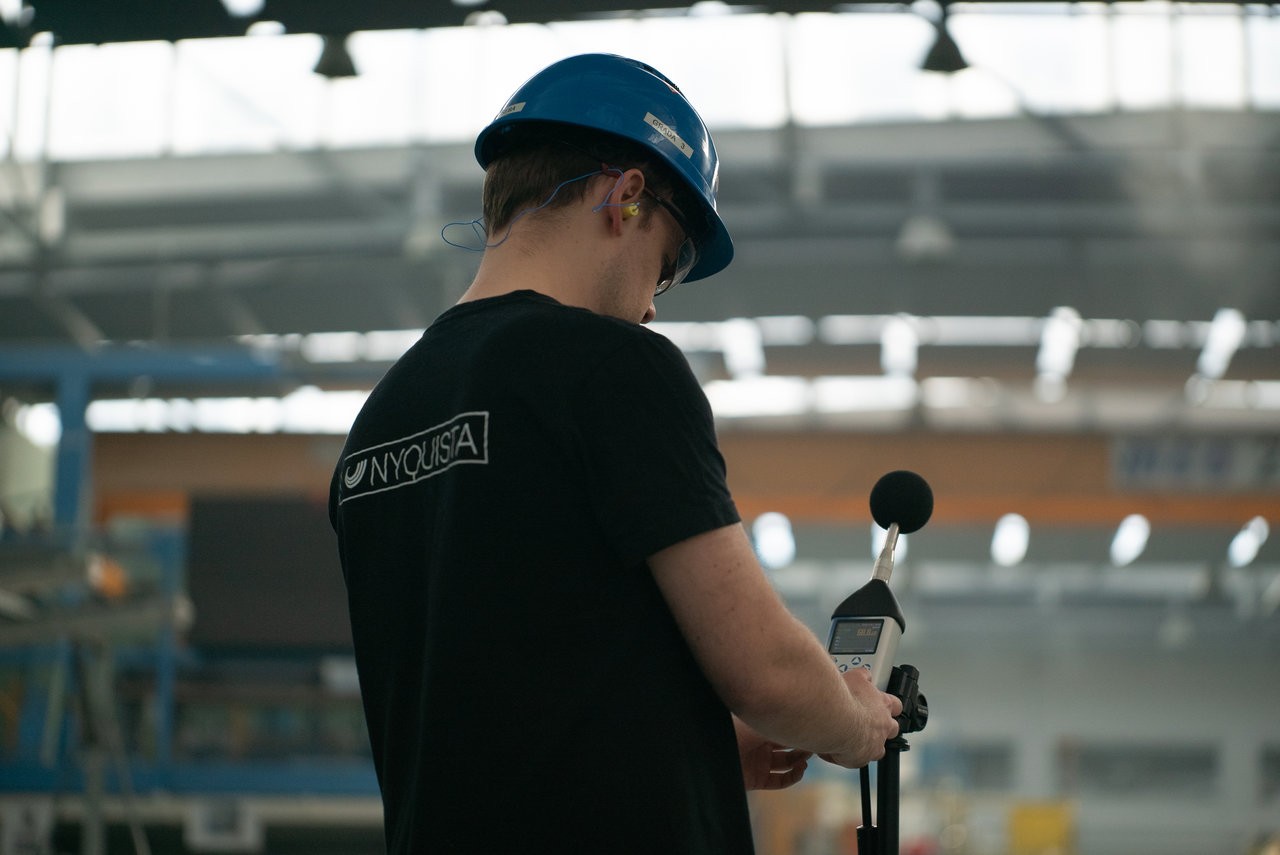
Exposure measurements are the only tool that translates the subjective impression of "it is loud in the hall" into hard, objective legal evidence. At Nyquista, we provide precise data for each workstation (LEX,8h value), compared with the strict limits of the Labor Code. We do not measure machine noise. We measure your business risk.
Why is placing a meter next to a machine not enough?
Many employers mistakenly believe that measuring the volume of the loudest press solves the problem. This is a trap.
Occupational exposure is not a temporary reading. It is the cumulative "dose" of acoustic energy that an employee absorbs during an 8-hour workday. It includes time spent at the machine, moving around the hall, breaks, conversations, and the variability of the production cycle.
Two seemingly identical workstations can generate a completely different dose of noise. Employee "A" operates a milling machine for 6 hours. Employee "B" operates it for 2 hours and spends the rest of the shift in the warehouse. A standard measurement "at the machine" will not reveal this difference. A reliable assessment according to the ISO 9612:2025 standard analyzes this process with surgical precision.
When is a professional measurement your duty?
Our services are the foundation of safety in industry:
Occupational Risk Assessment (Legal requirement): Labor law and ministerial regulations (NDN) categorically oblige the employer to assess risk at workstations exposed to noise. An assessment based on a certified measurement is the only document that truly protects you in court.
PIP (National Labour Inspectorate) or Sanepid (Sanitary Inspectorate) visit: A labor inspector will ask one question: "what is the operator's exposure at workstation X?". The correct answer is a specific number, backed by a report. The lack of current measurement documentation indicates one thing to the inspector: a violation of OHS regulations.
Investment verification (ROI): Have you installed soundproof screens, changed the work organization, or enclosed a noisy generator? A measurement "after changes" is the only way to verify whether the spent budget yielded the assumed protective effect.
Selection of hearing protectors (PPE): Hearing protection purchased "by eye" is a hazard. An under-protecting device does not prevent deafness. An over-protecting device (over-attenuation) isolates the worker, preventing them from hearing warning signals (e.g., a forklift horn), which leads to accidents. The selection of hearing protectors must strictly be based on the actual noise spectrum at the workstation.
Where do we work?
We operate in environments with the highest level of acoustic difficulty:
Production halls, assembly lines, workshops and carpentry shops, logistics centers and warehouses, sorting facilities, maintenance facilities, and all processing plants.
How do we measure? (Technology and Standards)
In OHS matters, there is no room for estimates. We apply the methodology of the latest ISO 9612:2025 standard. Depending on the specifics of the workstation, we select the optimal strategy: analysis of individual tasks, analysis of the entire job, or full-day dosimetric (personal) measurement.
We perform all tests using Class 1 accuracy equipment (calibrated). We refer the measured values to strict Polish hearing protection standards:
LEX,8h = 85 dB (Permissible noise exposure level related to an 8-hour daily working time).
LAmax = 115 dB (Maximum A-weighted sound level).
LCpeak = 135 dB (Peak C-weighted sound level).
What do you get? A report ready for inspection
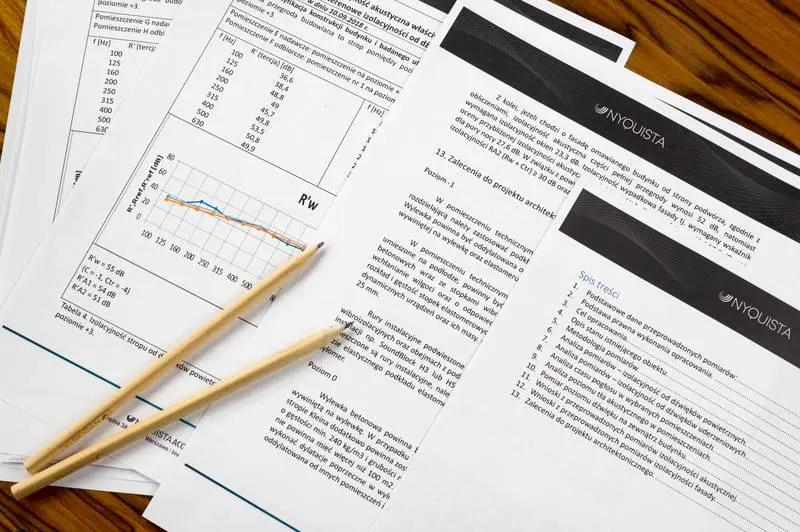
The final result of our work is a comprehensive engineering document. The report contains:
calculated exposure results for each workstation, comparison with critical values, an objective occupational risk assessment, and a clear indication of zones requiring priority intervention.
We also provide specific technical and organizational recommendations that will help you reduce noise in compliance with legal requirements.
Measurements of employee noise exposure level
Occupational hearing loss is diagnosed on average after 10–15 years of working in noise. An employer who, after that time, does not have archived measurement documentation is left with no defense in court. Don’t take the risk. Let’s measure it.


Our design process
Step 1 — Gathering information
It only takes a short phone call, email, or a form on the website to start working together. Already during the first conversation, we preliminarily get to know your needs and arrange a convenient time for a meeting or a visit to your space. It's a simple step that paves the way to ideal acoustics.
See our solutions live
Office / Showroom
Production / Warehouse
Let's do something together
Use the form - we will respond as soon as possible!