
|
Nyquista Team
We close the door to an office, a conference room, an apartment, or a recording studio and intuitively assume that the noise will remain on the other side. After all, there is a partition between the rooms designed to separate one space from another. In practice, however, it turns out that even after closing the door, we can still hear conversations, music, or other sounds coming from adjacent rooms. For many people, this is surprising, especially when a door designated by the manufacturer as acoustic has been installed.
Sound is an invisible phenomenon
A sound wave does not "know" it is supposed to pass through the center of the door. Instead, it seeks the path of least resistance. In practice, this means that even a very heavy and massive door leaf may fail to provide the expected acoustic insulation if there are leaks or other easier transmission paths around it.
This is precisely why the acoustic performance of a door is a much more complex issue than it might appear at first glance. The final result is determined not only by the design of the leaf, but also by a series of seemingly less important elements, such as the frame, seals, threshold, lock, and the installation method of the entire door assembly.
The door as an element of the acoustic insulation system
It is a common belief that the acoustic insulation of a door depends primarily on its thickness and mass. Indeed, according to the fundamental laws of acoustics, heavier partitions are generally more effective at limiting sound transmission. In practice, however, the door itself must be treated not as a single component, but as a complete system.
In addition to the door leaf, a significant role is played by the frame, hinges, perimeter seals, threshold, and the connection between the door and the wall. Each of these elements affects the tightness of the entire system and can determine its final effectiveness. From the perspective of acoustic energy flow, a door is only as good as its weakest link.
The quality of workmanship and installation is also of key importance. Even the best product may fail to meet expectations if it is incorrectly fitted in the partition. This is why the parameters declared by manufacturers are not always fully reflected in actual operating conditions.
Small gaps, major consequences
One of the greatest challenges associated with the acoustic insulation of doors is leakage. For a user, a gap with a width of one or two millimeters seems virtually unnoticeable. For an acoustic wave, however, it can represent a highly efficient transmission path.
Returning to the analogy with water, it can be said that sound always attempts to find the easiest path. If even a small gap appears around the door, acoustic energy will penetrate through it much more easily than through a heavy and well-designed door leaf. As a result, the overall insulation of the system may be significantly lower than expected.
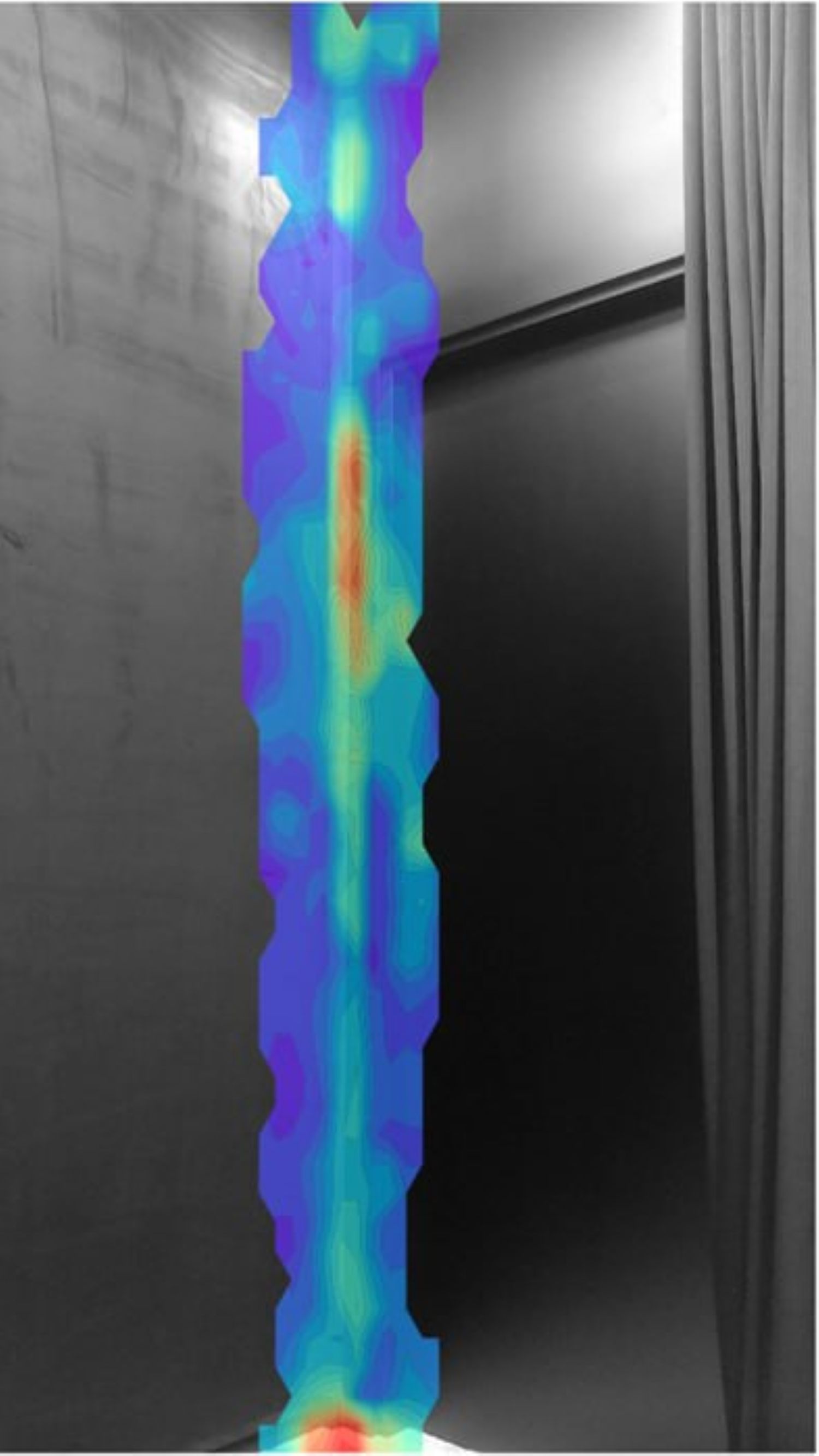
Figure 1. Air particle velocity distribution (u²) in the 180–10000 Hz frequency band, determined by the intensity method. Visible leaks in the area of hinges and frame edges are shown in the figure.
The areas around the bottom edge of the door, the contact points between the leaf and the frame, and the corners of the seals are particularly problematic. This is where localized leaks responsible for the degradation of acoustic comfort most frequently occur. In many cases, improving tightness yields a greater benefit than increasing the thickness of the leaf itself.
The role of the frame, lock, and hardware
When discussing door acoustics, relatively little attention is paid to the importance of the door frame. Yet, it is one of the key elements of the entire system. The interface between the frame and the wall is a common area for installation errors. Inadequate filling of the installation void or improper sealing can create additional paths for sound transmission.
The lock and hinges can also have a significant impact on acoustic properties. To install them, holes and routings must be made in the door leaf. This leads to localized changes in the mass and stiffness of the structure. Additionally, the areas around hinges and locks are frequent points of disruption in the continuity of the perimeter seal. Similar phenomena can occur around the handle and other hardware components, especially if they influence how tightly the leaf presses against the seals.
While the impact of these components may seem minor, they are often responsible for the discrepancies between the theoretical and actual acoustic insulation of a door.
Flanking transmission – when sound bypasses the door
One of the most interesting phenomena in building acoustics is flanking transmission. Most people assume that sound travels directly through the partition separating two rooms. In reality, it very often takes alternative paths.
Acoustic energy can propagate through adjacent walls, ceilings, floors, and structural joints. This means that even an exceptionally high-performing door does not always guarantee the expected acoustic comfort. If sound finds an easier path through other elements of the building, the effectiveness of the entire solution can be significantly limited.
This phenomenon is one of the primary reasons for the discrepancy between results obtained in laboratory tests and the performance achieved once the door is installed in a real building. In practice, users are often convinced that the issue lies with the door itself, whereas the actual cause is the connection between the frame and the wall, or another flanking transmission path.
Why laboratory and reality are not always the same
Acoustic door manufacturers specify parameters obtained during laboratory tests. Such measurements are conducted under controlled conditions, which allow for the comparison of different solutions and the evaluation of their effectiveness. In real buildings, however, the situation is much more complex.
The final performance is influenced, among other things, by the quality of installation, the precision of joints, the condition of the seals, structural deformation, and the presence of additional sound transmission paths. Consequently, the insulation performance achieved after installing the door may differ from the values obtained during laboratory testing.
This does not mean that laboratory results are useless. They serve as an essential benchmark, but their interpretation must always take real-world installation conditions into account.
How can you "see" sound?
For many years, identifying the areas responsible for the degradation of acoustic insulation was a major challenge. Classic measurements allowed for determining how much sound was transmitted from one room to another, but did not pinpoint the exact location of the defect.
The development of intensity methods has significantly changed this situation. By utilizing specialized probes, it is possible not only to determine the sound level but also to analyze the direction of acoustic energy flow. This allows for the creation of maps showing the areas through which sound penetrates most easily.

Figure 2. Air particle velocity distribution (u²) in the 400–9000 Hz frequency band on the door surface. The figure shows visible leaks in the area of the top and bottom door seals, as well as in the handle and lock region.
These types of measurements enable the localization of leaks occurring around seals, thresholds, locks, frames, or structural joints. In practice, they allow you to literally "see" acoustics and identify the source of the problem without the need for expensive trial-and-error work.
Modern diagnostic techniques demonstrate that building acoustics is not limited solely to measuring noise levels. Increasingly, it involves analyzing the flow of acoustic energy and understanding the mechanisms responsible for its transmission.
Summary
Sound, much like water, always tries to find the easiest path. In the case of doors, this path does not necessarily lead through the center of the leaf. It is often represented by small gaps, the area around the lock, the connection between the frame and the wall, or adjacent structural elements of the building.
This is precisely why the acoustic effectiveness of a door depends not only on its design, but also on the quality of workmanship, airtightness, and correct installation. Understanding these phenomena allows for better design of building partitions and more effective diagnostics of problems in existing facilities.
Modern measurement methods now allow us to observe phenomena that until recently remained invisible. Thanks to them, it is possible not only to determine that sound is penetrating a partition, but also to pinpoint the exact path it is taking.
Sources:
Asakura, T., & Sakamoto, S. (2013). Improvement of sound insulation of doors or windows by absorption treatment inside the peripheral gaps. Acoustical Science and Technology, 34(4), 241–252.
Hongisto, V. (2000). Sound insulation of doors—Part 1: Prediction models for structural and leak transmission. Journal of Sound and Vibration, 230(1), 133–148.
Sotiropoulou, A., Karagiannis, I., Papaioannou, M., & Badogiannis, E. (2019). Sound insulation performance of prefabricated concrete partitions in Hellenic school buildings. Journal of Civil Engineering and Architecture, 13(6), 353–372. Full text PDF.
Clasen, D., & Langer, S. (2007). Finite element approach for flanking transmission in building acoustics. Building Acoustics, 14(1), 1–14.
PN-EN ISO 10140-2:2021-10. Acoustics — Laboratory measurement of sound insulation of building elements — Part 2: Measurement of airborne sound insulation. Polish Committee for Standardization.
PN-EN ISO 16283-1:2014-05. Acoustics — Field measurements of sound insulation in buildings and of building elements — Part 1: Airborne sound insulation. Polish Committee for Standardization.
PN-EN ISO 15186-1:2005. Acoustics — Measurement of sound insulation in buildings and of building elements using sound intensity — Part 1: Laboratory measurements. Polish Committee for Standardization.

See also


Office / Showroom
Production / Warehouse
Let's do something together
Use the form - we will respond as soon as possible!