
|
Nyquista Team
Two different materials can have an identical NRC rating and yet perform completely differently in a real room. To understand why, one must first answer the question: what actually is sound absorption?
The Story That Started It All
Modern room acoustics have their roots at Harvard University in the late 19th century. Physicist Wallace Clement Sabine was tasked with improving the acoustics of one of the lecture halls, where students struggled to understand the lecturers. He had no computers, microphones, or specialized measuring equipment. Instead, he moved hundreds of seat cushions between rooms and measured the decay time of sound using a stopwatch.
In doing so, he discovered the relationship between the amount of sound-absorbing materials and reverberation time. The result of his research was Sabine's formula, which remains the foundation of architectural acoustic design to this day.
Thus, it can be said that modern acoustic panels owe their existence to experiments with cushions conducted over 120 years ago.
What is the Sound Absorption Coefficient α?
When a sound wave hits a surface, part of the energy is reflected, part transmits through, and part is absorbed by the material.
The degree of absorption is described by a coefficient denoted by the symbol α (alpha).
α = 0 means total reflection of sound,
α = 1 means total absorption.
In practice, however, a material does not have a single α value. Every frequency behaves differently. For example, a thin acoustic panel can achieve:
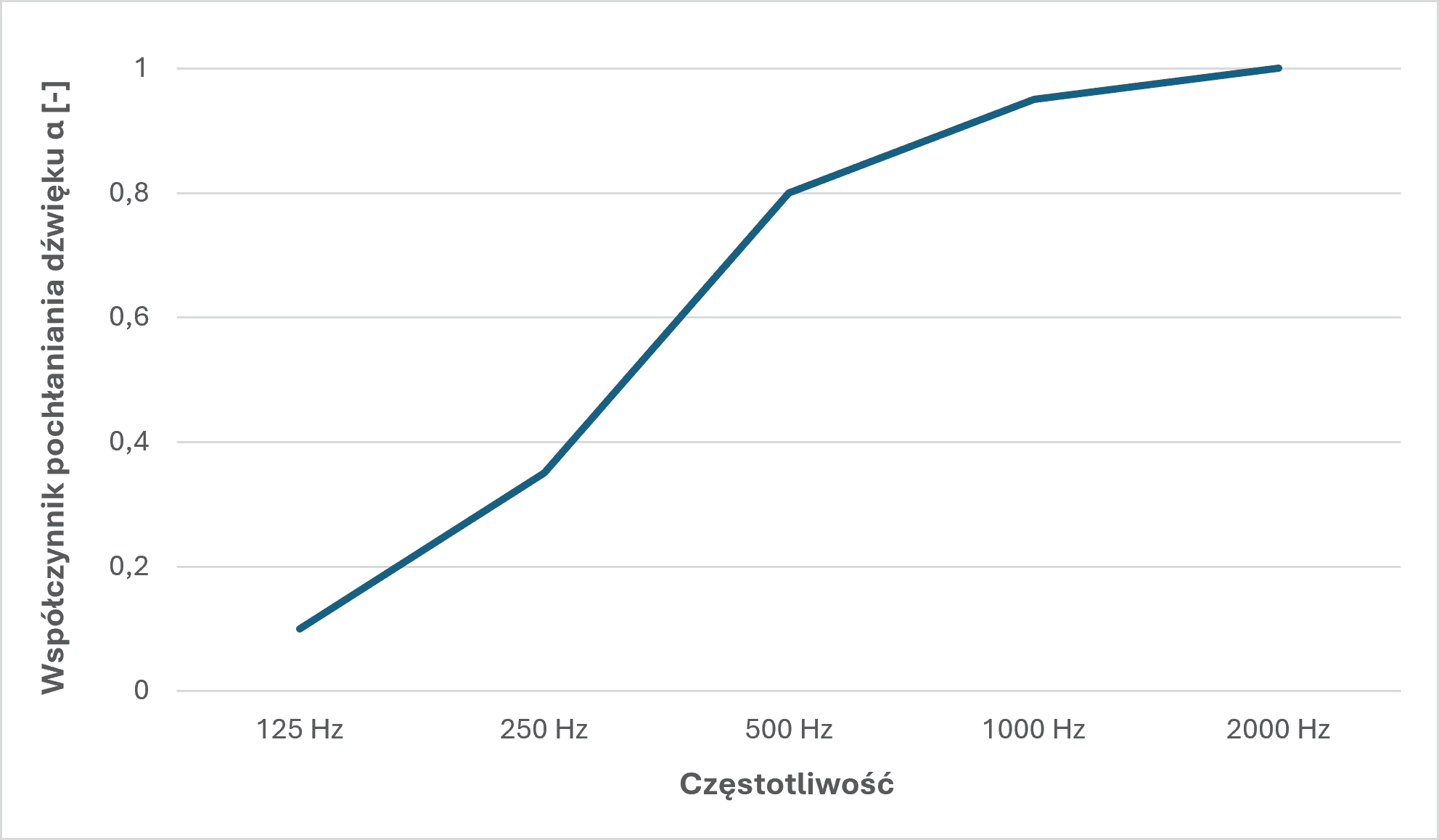
Figure 1. Sound absorption coefficient α for a thin absorbing panel
Table 1. Sound absorption coefficient α for a thin absorbing panel
Frequency | α |
125 Hz | 0.10 |
250 Hz | 0.35 |
500 Hz | 0.80 |
1000 Hz | 0.95 |
2000 Hz | 1.00 |
It is clear, therefore, that the same material performs poorly at absorbing low frequencies, but functions very effectively in the mid and high frequency ranges.
The α Coefficient Can Be Greater Than 1
This is one of the most surprising phenomena in acoustics.
While intuition suggests that the maximum should be 1, laboratory reports often show values such as 1.02, 1.05, or 1.10.
This does not mean that the material absorbs more energy than it receives. This is due to the specifics of measurements conducted in reverberation chambers and additional absorption at the edges of the sample. ISO and ASTM standards permit these results.
Why Was the NRC Developed?
A full material specification can contain dozens of values for different frequencies. While highly useful for acousticians, this is relatively inconvenient for clients. Therefore, the NRC (Noise Reduction Coefficient) rating was developed.
It is a simplified average of absorption at the following frequencies:
250 Hz,
500 Hz,
1000 Hz,
2000 Hz.
The higher the NRC, the greater the material's ability to reduce sound reflections.
Does the NRC Tell the Whole Story?
The NRC is convenient, but it has a significant limitation. It does not account for frequencies of 125 Hz and below, which are responsible for:
room boom,
HVAC noise,
low bass in music.
This leads to a highly interesting situation.
Two materials can have an identical NRC
Table 2. Comparison of sound absorption coefficients α for two different materials with the same NRC
| Material A | Material B |
Hz | α | |
125 | 0.10 | 0.7 |
250 | 0.85 | 0.8 |
500 | 0.90 | 0.85 |
1000 | 0.90 | 0.9 |
2000 | 0.85 | 0.95 |
Both can achieve a highly similar NRC. However, the first material is virtually ineffective at low frequencies, while the second absorbs sound much more evenly. Consequently, NRC alone is insufficient for a professional evaluation of a material.
What is the Difference Between α and αw?
These are two of the most frequently confused concepts.
α (alpha) – Describes the absorption at a specific frequency. Example: α = 0.80 at 500 Hz.
αw (weighted alpha) – This is a single-number rating determined in accordance with the ISO 11654 standard based on the complete curve of the absorption coefficient.
It can be said that αw is the European equivalent of a simplified material rating. However, unlike NRC, it takes into account a broader range of measurement data.
Sound Absorption Classes
One of the greatest benefits of αw is the ability to assign a material to a absorption class.
Table 3. Classification of materials according to their weighted sound absorption coefficient αw
Class | αw |
A | 0.90–1.00 |
B | 0.80–0.85 |
C | 0.60–0.75 |
D | 0.30–0.55 |
E | 0.15–0.25 |
In practice:
Class A indicates highly effective absorption.
Class C provides moderate acoustic improvement.
Classes D and E are typically used where acoustic performance is not a primary focus.
Class A Does Not Mean an "Ideal" Material
This is another common myth.
A material with αw = 0.95 may deliver outstanding results at high frequencies while performing moderately at low frequencies. Therefore, professional acoustic designers analyze not only the absorption class but also the complete curve of the α coefficient.
Does Panel Thickness Matter?
The lower the frequency, the longer the sound wave. For example:
100 Hz ≈ 3.4 m length,
50 Hz ≈ 6.8 m length.
This is why a thin decorative panel with a thickness of 10 mm can perform excellently at high frequencies, yet have virtually no effect on low-frequency room modes. Effective bass absorption typically requires thicker materials or specialized acoustic treatments.
What to Look For When Selecting Acoustic Materials?
If the manufacturer provides comprehensive data, it is recommended to analyze it in the following order:
The curve of the absorption coefficient α.
The αw rating.
The absorption class.
The NRC rating.
The more detailed the measurement data, the easier it is to assess the actual properties of the material
The sound absorption coefficient describes how effectively a material converts acoustic energy into heat rather than reflecting it back into the room. The α parameter shows the performance of the material at a specific frequency, NRC represents a simplified rating used primarily in North America, while αw is the European standard that also allows the material to be assigned to an absorption class from A to E. Although single-number ratings are convenient, the most valuable information remains the complete absorption curve as a function of frequency, since two materials with an identical NRC can perform completely differently in a real space.

See also


Office / Showroom
Production / Warehouse
Let's do something together
Use the form - we will respond as soon as possible!