|
Nyquista Team
The Difference Between a Sound Level Meter and a P-U Probe in Measurement Practice
Occasionally, upon entering a room, we immediately perceive that "it is loud." The noise is distinct, conversation requires a raised voice, and yet it is difficult to identify the culprit. Is it the ventilation system? Vibrations transmitted through the building structure? Leaky windows or doors? Or perhaps an acoustic bridge invisible to the naked eye? In such situations, the decibel level alone proves insufficient – we require a tool that demonstrates not only the volume but also the actual path and source of the sound transmission.
When discussing noise measurement, we most frequently think of a decibel figure. 65 dB, 85 dB, 100 dB - these values have become virtually synonymous with noise assessment. In engineering and environmental practice, the primary measurement tool is the sound level meter, constructed in accordance with the IEC 61672 standard. This device measures sound pressure and converts it into a level expressed in decibels, often utilizing A or C frequency weightings.
This is a correct, standardized, and, in many applications, completely sufficient method. If the objective is to assess employee exposure, monitor environmental noise, or verify compliance with regulations, the sound level meter performs its function excellently. It answers the question: how large are the pressure fluctuations at a given location? However, it does not indicate how much acoustic energy is actually moving through space, nor does it show the path through which this energy escapes.
Intensity Probe – Visualizing Energy Flow
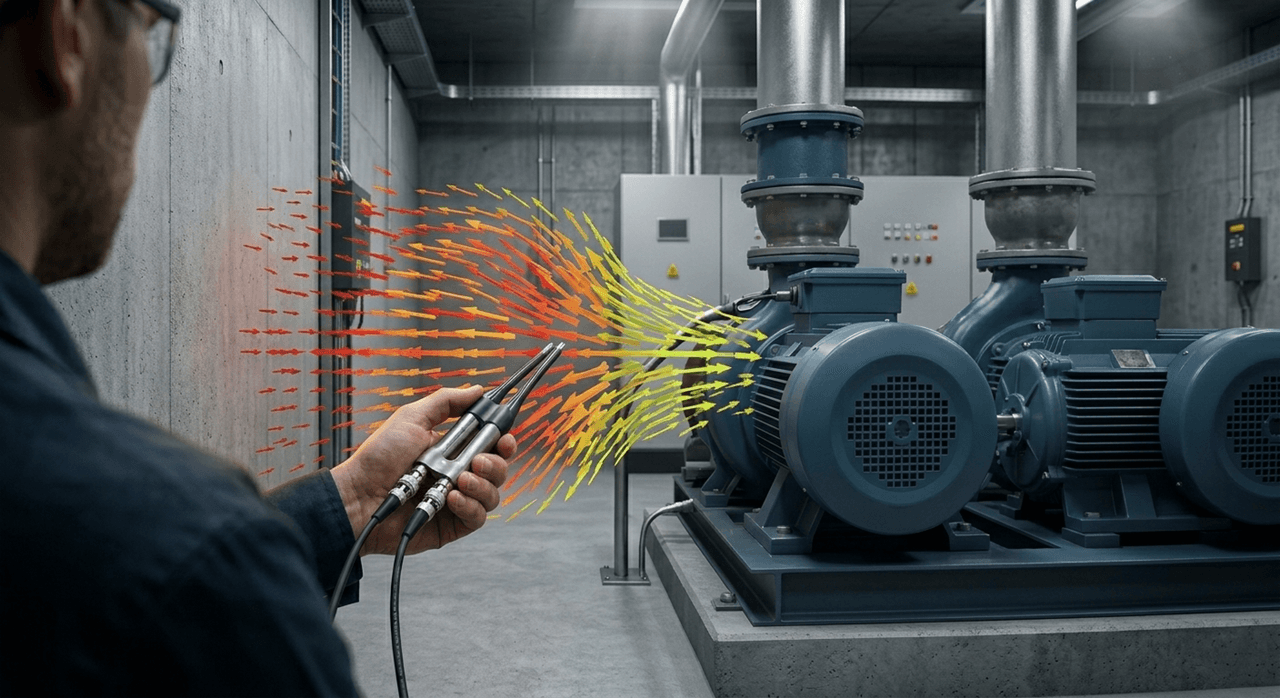
A sound wave consists not only of pressure changes but also of the movement of air particles. Only the product of pressure and particle velocity yields sound intensity – which represents the density of the acoustic energy flow. This is precisely the quantity measured by the p-u intensity probe.
The difference is fundamental: intensity is a vector quantity. This means it contains information not only regarding "how much" but also "in which direction." Consequently, intensity measurement is not limited to a point value in decibels. It illustrates the flow of energy.
In practice, this provides an invaluable benefit: the probe allows for the creation of a map of emissions. When scanning the surface of a wall, a machine casing, or a building partition, we obtain an image showing where acoustic energy is actually passing through and with what intensity. This is no longer a single number – it is spatial information regarding the "escaping" sound.
In industrial or structural diagnostics, this aspect is often critical. The engineer does not have to guess the source of the problem. They can see it.
Room Field vs. Actual Flow
Under typical measurement conditions – in halls, offices, or apartments – sound reflects repeatedly off walls, ceilings, and furnishings. At the measurement point, waves from multiple directions overlap. The sound level meter registers the cumulative pressure fluctuations but does not distinguish whether the energy is actually traveling through the tested surface or merely oscillating in space.
Thus, it may indicate a high dB level in a location where the energy flow is minimal. In such a scenario, we know that "it is loud," but we do not know the path the sound is taking, nor which structural elements are responsible for the transmission.
The intensity probe eliminates this ambiguity. It measures the actual energy flow passing through the tested surface, separating what is truly traveling from what is merely reflecting and interfering.
Sound Power – From Numbers to Images
In sound power measurements of machinery, classical pressure-based methods require specific acoustic conditions to be met – the key here is the distinction between sound power level and sound pressure, which determines the choice of testing procedure. Sound power is determined indirectly, taking into account the room characteristics. The procedure is valid and widely used, but it yields a single global value.
The intensity method operates differently. By scanning the surface enclosing the source, we directly integrate the energy flow. Consequently, we obtain not only the total sound power but also information on its spatial distribution. It is possible to identify which part of the machine casing radiates most intensely, where the structural weak points are located, and which elements require modification.
This changes the nature of the measurement – from a verification tool to a diagnostic one.
Acoustic Insulation – Finding the Bridge, Not Just the Result
A similar difference arises when measuring the insulation of building partitions. The classical method relies on measuring pressure levels in the source and receiving rooms, while accounting for reverberation time. This yields an insulation value describing the performance of the partition as a whole.
Conversely, the intensity method allows for a "local" approach to the partition. By scanning its surface, one can detect areas where energy penetrates more intensely – gaps, installation inaccuracies, or structural joints. As a result, instead of merely stating that the insulation is insufficient, the specific cause of the issue can be identified.
It is this visual and diagnostic capability that makes the intensity probe not just a measurement tool, but a design tool.
Two Tools, Two Objectives
This does not mean, of course, that the sound level meter loses its significance. In environmental noise assessment, compliance analyses, or human exposure studies, sound pressure level remains the fundamental metric. It is this parameter that correlates with human perception and legal regulations.
The intensity probe, however, answers a different question: not "how loud is it?", but rather "how much energy is actually flowing, and which way?"
Conclusion – From Numbers to Understanding
The difference between a sound level meter and an intensity probe is not a matter of accuracy, but of perspective. One instrument provides point-specific information on the state of the acoustic field. The other allows one to see the dynamics of energy flow through space.
Modern acoustic engineering increasingly requires more than just a decibel figure; it demands an understanding of the emission and transmission mechanisms. Where the key question is "from where and by how much is sound escaping," the intensity probe ceases to be an alternative – it becomes the primary tool of choice.

See also


Office / Showroom
Production / Warehouse
Let's do something together
Use the form - we will respond as soon as possible!