|
Nyquista Team
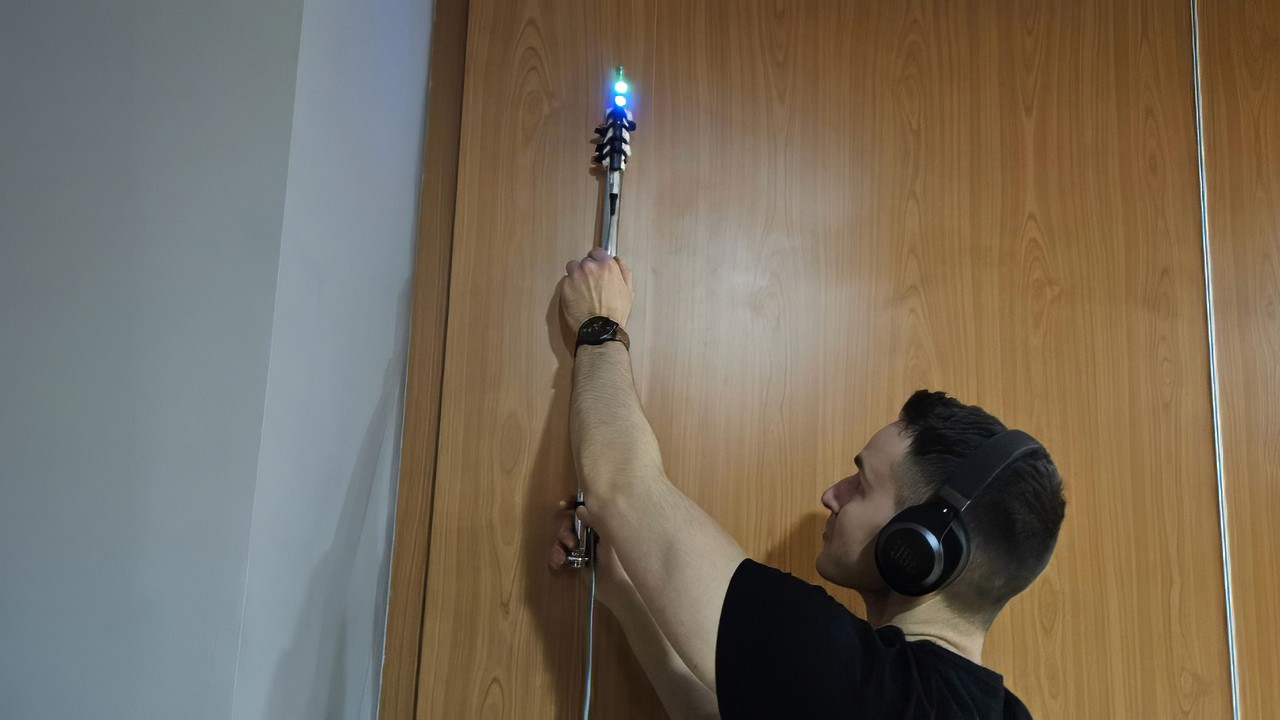
So what does such a probe actually measure? As the name suggests, an intensity probe is used to measure sound intensity, i.e., the amount of acoustic energy passing through a unit area together with information about its propagation direction. In practice, this means it does not merely show the “noise level,” but allows specific locations through which sound penetrates or from which it is emitted to be identified.
For comparison, classic sound level meters record only acoustic pressure – a scalar value expressed in decibels (dB). They tell us that there is a certain noise level in a room, but they do not indicate where the sound energy is actually flowing.
So it can be said that pressure measurement answers the question: “how loud is it?”, while intensity measurement answers the question: “where and in which direction is sound flowing?”.
What does measurement using the intensity method provide?
The greatest value of this method is the ability to move from a general diagnosis to identifying a specific problem location. Instead of the information: “insulation is too low,” we get an answer such as: “acoustic energy is penetrating through the wall-to-slab joint in the area of the ventilation installation.” This is a fundamental difference.
Thanks to this precision, it is possible to formulate very specific corrective guidelines. Instead of implementing costly and space-intrusive solutions – for example, building additional lining walls that reduce room area – it is often enough to seal a specific joint or properly insulate the indicated installation. In practice, this means shorter repair time, a smaller scope of work, and lower investment costs.
The intensity method also allows you to:
detect point leaks,
distinguish sound actually penetrating through a partition from reflected sounds,
reduce the impact of background noise on the measurement result,
conduct tests under actual operating conditions of the facility.
This makes it possible to analyze even very complex acoustic systems in which a classic sound level measurement does not allow the source of the problem to be clearly identified.
What does airborne sound insulation measurement of a wall look like using the pressure method?
Airborne sound insulation testing is performed in accordance with PN-EN ISO 16283-1. In the source room, a controlled acoustic signal is generated – most often pink noise – which evenly excites the partition over a wide frequency range. In the receiving room, sound level and reverberation time measurements are carried out.
Why do we measure reverberation time? Because the amount of energy “remaining” in the room affects the final insulation result. For the result to be reliable, the acoustic conditions in the receiving room must be taken into account.
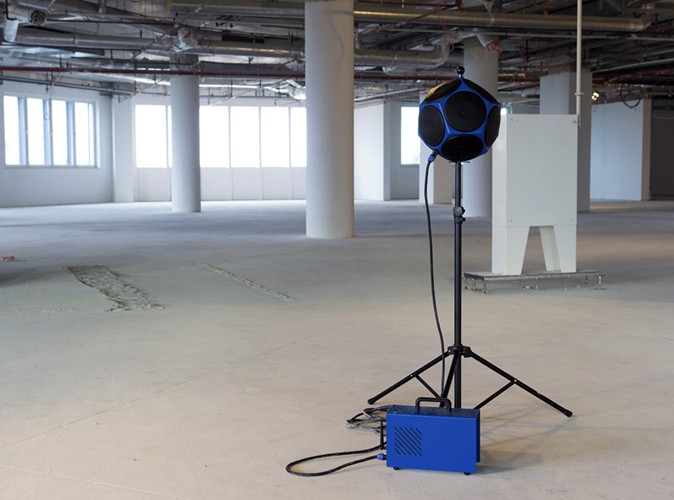
During measurements, the following are determined, among others:
R’w – weighted index of apparent sound reduction index,
R’A1, R’A2 – including spectral adaptation terms C and Ctr,
LAeq, LAmax – sound levels,
RT30 – reverberation time in the receiving room.
After measurements are completed, an analysis compliant with PN-B-02151-3 is carried out, including verification of design documentation, assessment of compliance with standard requirements, and preparation of possible corrective guidelines.
The final result is a specific numerical value of the partition’s insulation, which allows the question to be answered: does the wall meet the standard requirements or not.
And this is where a significant limitation of this method appears – although it precisely determines the insulation level, it does not clearly indicate where the acoustic energy is penetrating. It informs about the effect, but does not always allow the cause of the problem to be identified.
How do we locate acoustic bridges in practice?
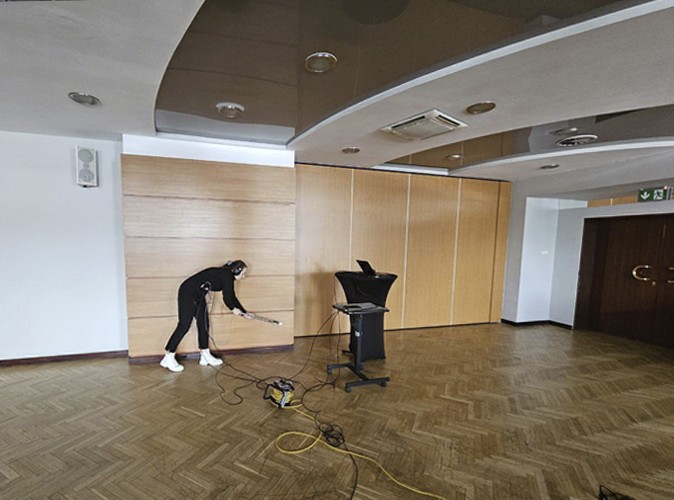
The PU intensity probe enables point or scanning sound intensity measurements directly at the partition surface. In contrast to classic “in-room” measurement, here we examine what happens right next to the wall.
In practice, the measurement consists of slowly, systematically moving the probe across the partition surface – similarly to thermal imaging camera testing. The device records not only the level of acoustic energy but also the direction of its flow.
Thanks to this, we can:
locate acoustic bridges,
detect installation leaks,
identify areas with different construction or stiffness,
determine to what extent a given location affects the resulting insulation of the partition.
The result of the measurement is a sound intensity distribution map – a graphical representation of areas, in the form of a color map of acoustic velocity distribution, where acoustic energy actually penetrates through the partition. This is a particularly effective tool in diagnostics of:
structural connections,
service penetrations,
wall and slab joints,
areas around door and window joinery.
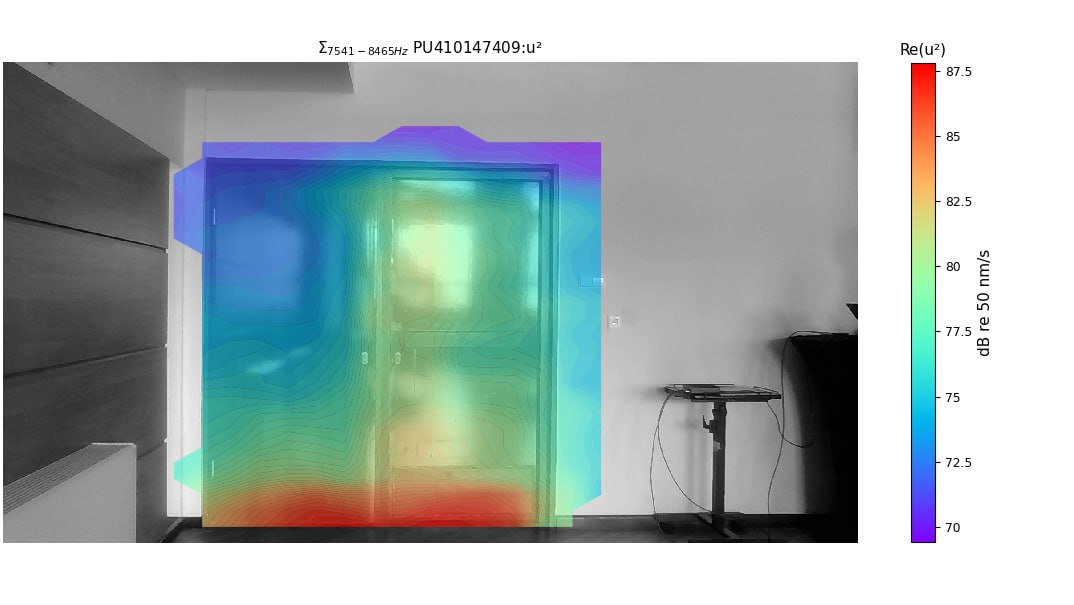
It is precisely in these places that acoustic bridges most often arise, which may determine failure to meet insulation requirements, even though the partition itself was designed correctly.
How can intensity methods be used to test the acoustic characteristics of technical equipment?
The acoustic parameter describing the operating characteristics of technical equipment is the sound power level, LW. This quantity defines the total acoustic energy emitted by the source (e.g., a heat pump) per unit time. Unlike sound pressure level, which depends on distance and room conditions, sound power level describes the device itself – regardless of the measurement location. It can be said that it is the equivalent of a “light bulb’s power,” not the brightness at a specific point in a room.
This parameter is crucial in:
designing production halls,
analyzing sound propagation in space,
assessing equipment compliance with environmental requirements.
Not every manufacturer provides the sound power level, so it is often necessary to determine it by measurement.
There are 3 basic measurement methods:
Measurement in an anechoic chamber – according to PN-EN ISO 3745 (highest accuracy, laboratory conditions)
Pressure-method measurement in in situ conditions – according to PN-EN ISO 3746 (lower accuracy, higher sensitivity to hall conditions).
Intensity-method measurement in in situ conditions – based on PN-EN ISO 9614.
It is this third method that is most often the optimal solution for industry.
The comparison below shows that the intensity method is a particularly effective solution in production conditions, where both accuracy and operational continuity matter.
Method | Advantages | Disadvantages |
1. |
|
|
2. |
|
|
3. |
|
|
In practice, this means that the PN-EN ISO 9614 method is often the only solution that allows a reliable result to be obtained without stopping production.
This method makes it possible to determine the device sound power level without the need for an anechoic chamber. Importantly, it does not require complete shutdown of other equipment in the production hall, which significantly reduces downtime-related costs.
The measurement is carried out in several stages:
the so-called measurement surface is defined around the device (a closed envelope surrounding the machine),
this surface is divided into measurement elements,
sound intensity measurements are performed using the point method or scanning,
quality criteria are verified (impact of background noise, uncertainty, field stability).
In practice, this means that we create an “imaginary solid” surrounding the device and measure the acoustic energy flux “flowing out” through its surface. Based on the recorded energy flux, the device sound power level is calculated.
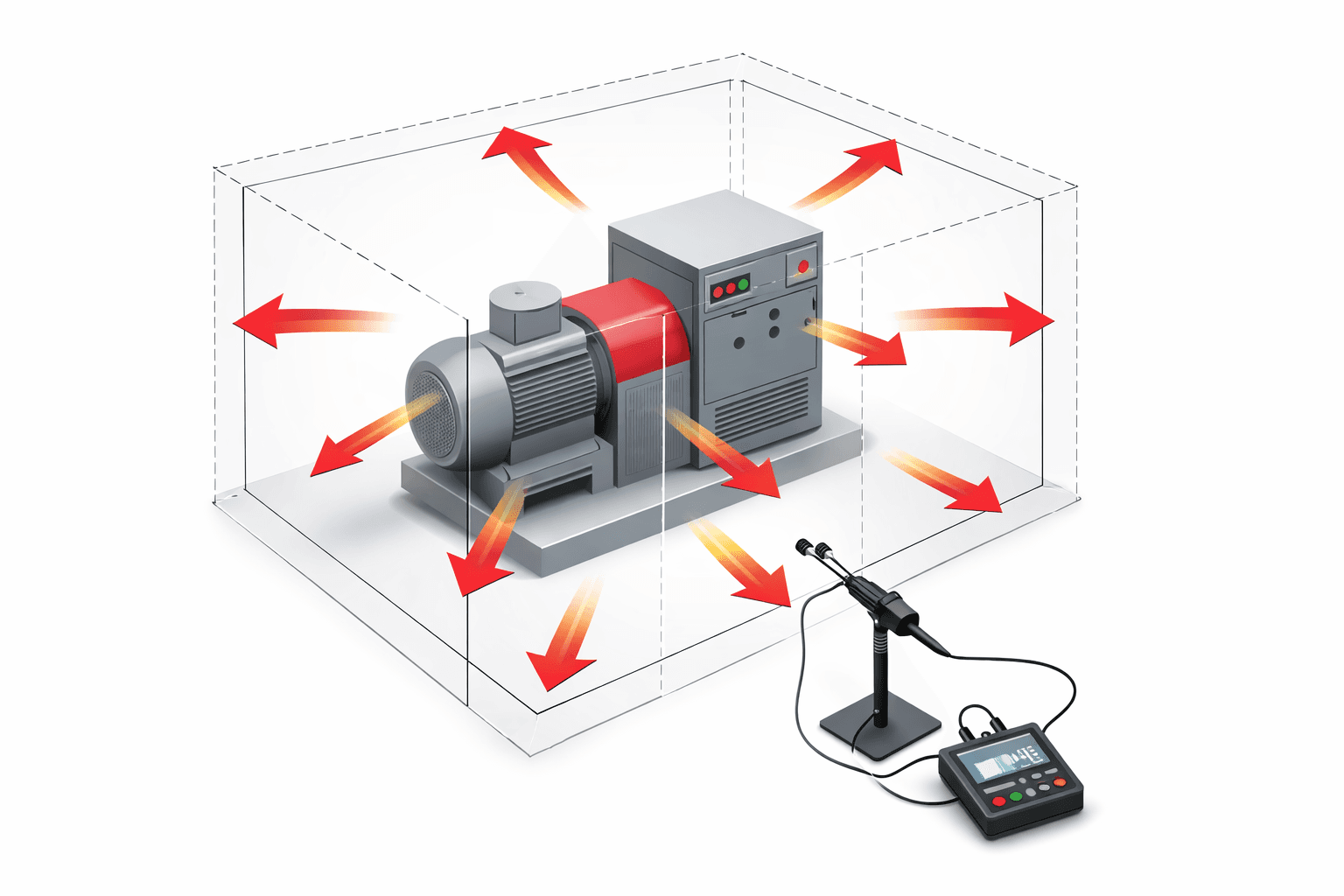
An additional, very important advantage of this method is the ability to precisely indicate machine components generating the greatest noise – which is not possible with methods based solely on acoustic pressure measurement.
In industrial practice, hall reverberation time measurements (RT20, RT30) are also often performed to characterize the acoustic conditions of the production space and correctly interpret the results.
It often happens that facility users hear noise or perceive a “sound leak,” but are unable to identify its actual source. In many cases, the problem does not result from the partition itself, but from flanking transmission paths – through slabs, installations, assembly gaps, or structural details. In such situations, the intensity method allows moving from assumptions to precise localization.
The intensity probe allows headphones to be connected and listening to an amplified signal of both acoustic pressure and acoustic velocity. Thanks to this, the operator “hears” the actual flow of acoustic energy at a given point of the partition. In practice, this means much greater sensitivity and directionality than with ordinary organoleptic listening. Instead of a general impression that “something can be heard somewhere here,” it is possible to indicate very precisely the place where sound energy actually penetrates.
The test procedure usually includes:
preliminary listening to narrow down the problem area,
detailed scanning of selected partition fragments,
visualization of sound intensity distribution,
identification of locations requiring correction of structural details.
Only in areas of the greatest leaks are detailed scanning measurements performed, on the basis of which specific corrective guidelines are formulated.
Summary - why is the intensity method so effective?
Classic sound level measurement answers the question: “How loud is it in a given place?” The intensity method answers the question: “From where and through which path does acoustic energy flow?”. This difference changes the way acoustic diagnostics are conducted.
Thanks to the intensity method, we can:
precisely locate acoustic bridges,
assess the quality of partition execution,
verify installation correctness,
determine the actual sound power of devices,
develop effective, targeted corrective solutions instead of costly “blind” actions.
It is precisely the ability to indicate the specific location of energy flow that makes the intensity method such an effective diagnostic tool – both in construction and in industry.
Each test ends with preparation of a detailed report, which includes:
a description of the facility and measurement conditions,
a list of the equipment used,
reference to applicable standards,
measurement results together with analysis
precise technical recommendations for removing the identified problem.
Thanks to this, the investor or facility manager receives not only a diagnosis, but also specific, technically justified guidelines for further actions.

See also


Office / Showroom
Production / Warehouse
Let's do something together
Use the form - we will respond as soon as possible!