|
Nyquista Team
When What We See Affects What We Hear
The human brain does not process the senses in isolation. Visual, auditory, and tactile information is integrated into one coherent picture of reality. This phenomenon is called multisensory integration (cross-modal perception).
In practice, this means that visual signals can influence the interpretation of what we hear. Similar examples are known in sensory psychology—for example, the color of a drink can affect the assessment of its taste, and the appearance of an instrument can change the way we evaluate its sound. Increasingly, similar relationships are also being studied in the context of architectural acoustics.
Study: Room Color and Perception of Sound
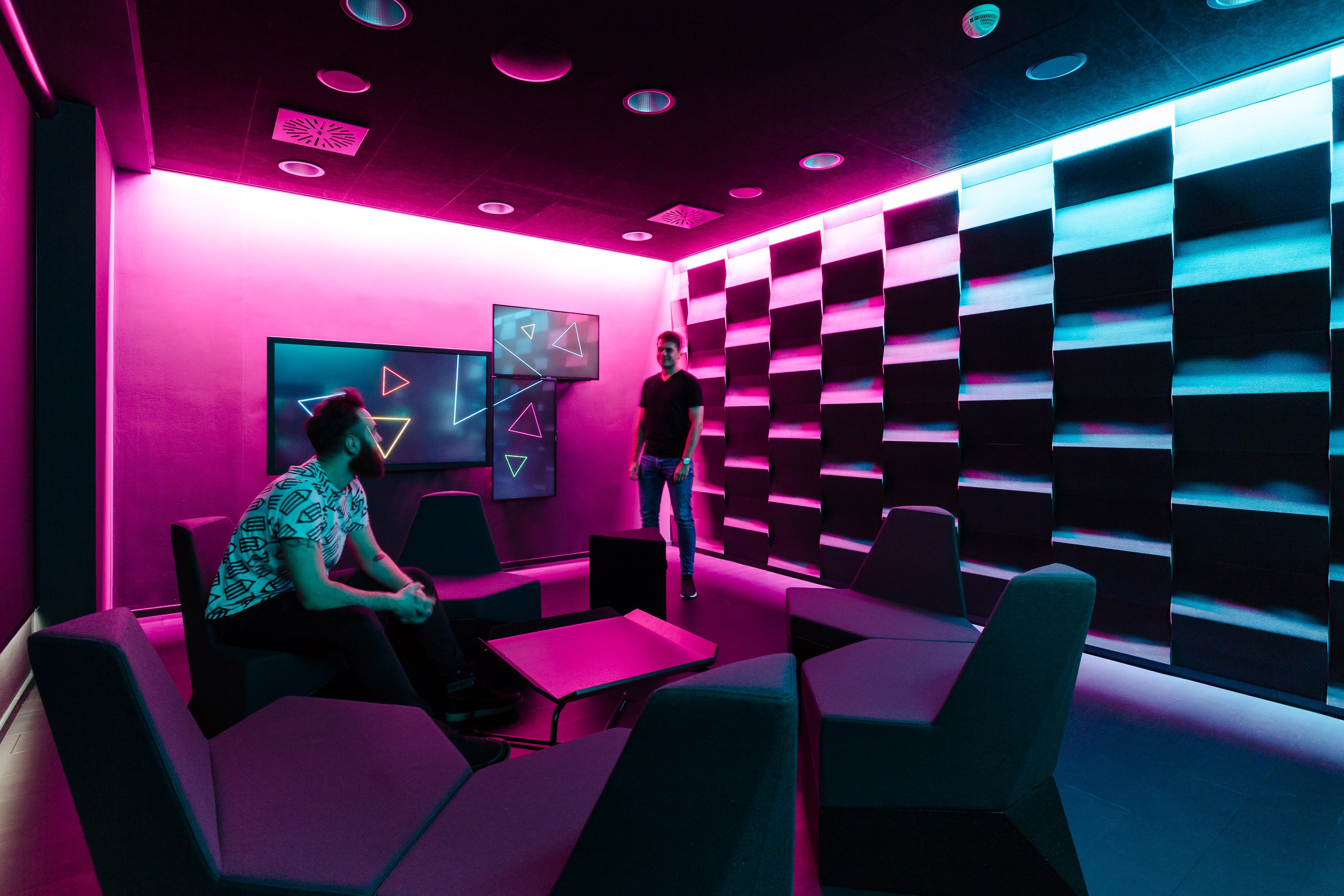
In February 2026, a study was published in The Journal of the Acoustical Society of America analyzing whether the interior color scheme of a concert hall can affect the perception of music. In the experiment, participants listened to music recordings in a virtual concert hall. The room acoustics remained identical in every case—only the interior color scheme presented visually to participants was changed.
Listeners evaluated various aspects of the sound, such as:
timbre,
the impression of sound “warmth” or “coolness,”
loudness,
reverberation,
overall listening quality.
The results showed that the color of the room can affect the perception of sound timbre—that is, whether the music seems more “warm” or “cool.” For example, intense shades of green and blue were more often associated by participants with a cooler sound.
At the same time, the study showed that color scheme did not affect loudness ratings or reverberation time. This means that fundamental acoustic properties remain dependent on the physics of the room—while the subjective interpretation of the sound changes.
Interestingly, study participants often rated listening in darker interiors better than in bright, intensely colored spaces.
What Does This Mean for Designing Listening Rooms?
In acoustic design of listening rooms, we focus primarily on elements such as:
control of reverberation time,
uniformity of frequency response,
reduction of early reflections,
appropriate diffusion and absorption.
However, research on multisensory perception suggests that the visual character of a space can influence the subjective evaluation of sound.
This does not mean, of course, that wall color will replace acoustic treatment. However, it may subtly change the way users perceive sound in a room.
In practice, this means that when designing listening spaces, it is worth considering not only acoustic parameters but also the visual coherence of the interior with the character of the listening experience.
For example:
darker, more subdued interiors may foster concentration on sound,
limiting very intense colors may reduce visual distraction,
a coherent spatial aesthetic may enhance the impression of a “controlled” listening environment.
Acoustics Is Also Psychoacoustics
Room acoustics is the science of sound wave propagation in space. However, music perception always takes place in the human brain, and therefore is also subject to the laws of perceptual psychology.
Research on the impact of room appearance on sound perception shows that acoustics is not only about measurements and graphs. It is also about how users perceive the space in which they listen to music.
A well-designed listening room should therefore operate on two levels at once: provide controlled acoustic conditions while also creating an environment conducive to focusing on sound.
The Journal of Acoustical Society of America - The influence of the color design of auditoriums on room acoustic impression

See also


Office / Showroom
Production / Warehouse
Let's do something together
Use the form - we will respond as soon as possible!