|
Nyquista Team
Acoustic Mirrors and Self-Amplifying Noise
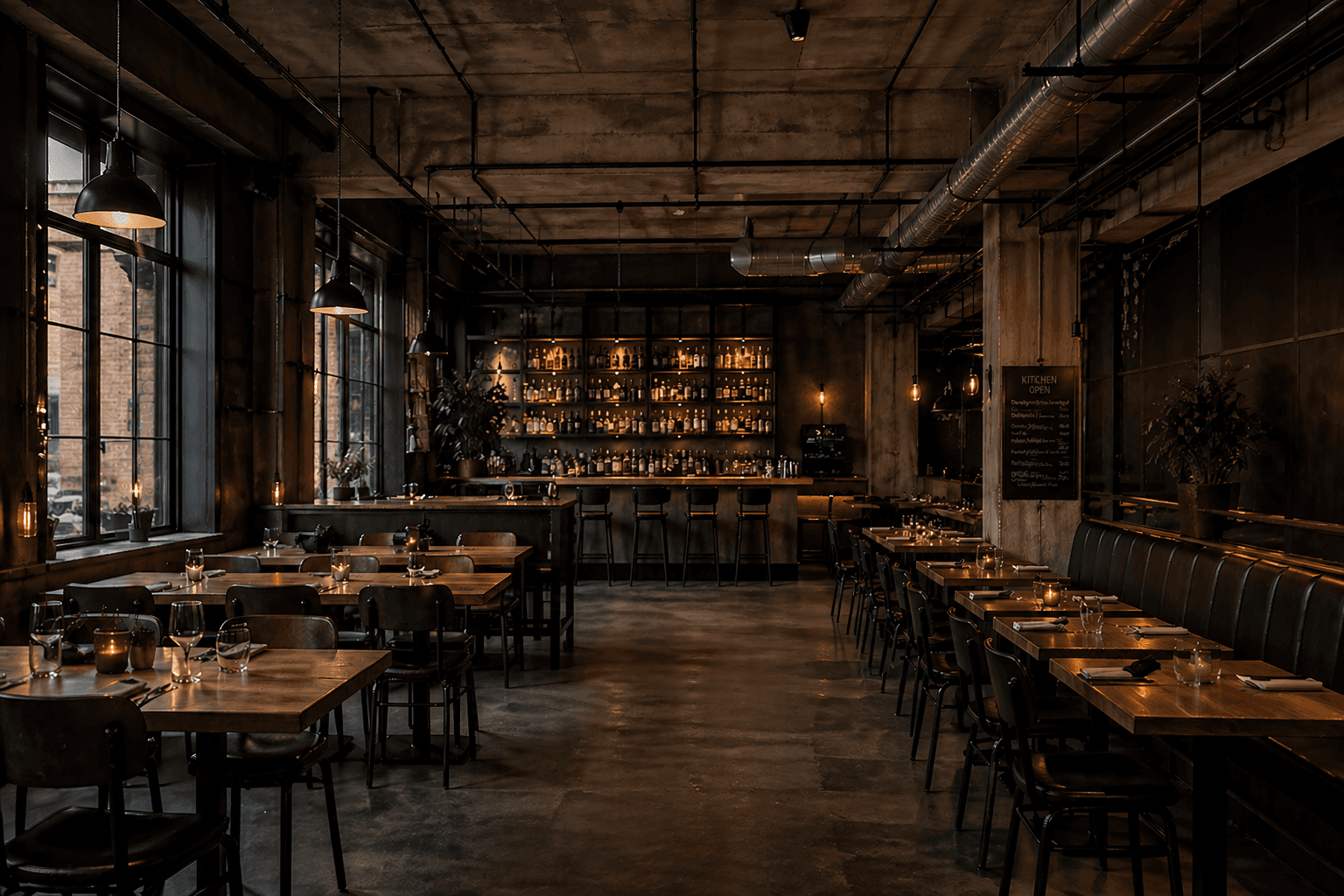
The phenomenon of overwhelming din in dining spaces is not accidental, but a result of wave mechanics. By choosing hard finishing materials, architects create so-called acoustic mirrors inside the venue. Glass or tiles do not absorb sound energy; they reflect it back into the room.
As a result, sound “lives” in the space much longer than it should. Measurement equipment shows that in raw interiors, reverberation time (referred to in engineering as the RT60 parameter) reaches 1.5, and even 2 seconds. The gold standard for places where we want to converse freely is only 0.6–0.8 seconds.
When sound reflects off the walls for two seconds, a new wave (e.g. the clatter of dishes from an open kitchen or the hum of air conditioning) overlaps with the previous one. This creates the so-called Lombard effect. Guests stop hearing their conversation partners, so they automatically raise their voices. The table next to them does the same. Within a dozen minutes, the room drives itself up to a level exceeding 75 dB, forcing everyone to shout.
The Biology of Noise. How Does Noise Modify Guest Behavior?
For an investor, auditory parameters are not merely an interesting topic from physics - they are indicators directly correlated with revenue. The human nervous system treats continuous noise above 75 dB as a physical stressor. Instead of relaxation, the brain shifts into vigilance mode, which radically changes consumer behavior.
Market data and analyses of the HoReCa industry mercilessly expose the costs of poor acoustics:
Time and money slipping away: Studies show that under increased noise, guests more often shorten their stay and spend less than in quieter conditions - differences can reach several dozen percent.
A receipt without dessert: A faster departure means giving up high-margin items. In noisy restaurants, the share of orders for desserts, coffee, or an additional bottle of wine drops dramatically.
Noise that changes taste: Analyses in the field of sensory perception prove that background noise literally deceives our taste buds. In a noisy environment, dishes seem less sweet and less salty. The chef loses control over how his menu is perceived.
Online rating: As many as 80% of customers in Poland treat acoustic comfort as a key element of the visit, placing it on par with service quality. Poor acoustics generate negative online reviews faster than a cold dish.
Law versus Reality: Where Is the Boundary of Investment Safety?
Data-driven architecture must also take legal frameworks into account. Although Polish legislation does not have a single standard reserved only for restaurants, that does not mean a free-for-all. Environmental protection law imposes strict limits on sound propagation outdoors (often 55 dB during the day and 45 dB at night).
From a design perspective, the key Polish standard is PN-B-02151-4:2015-06, which clearly recommends reducing reverberation time for public utility buildings. Treating these guidelines lightly is playing with business continuity. Neglect at the design stage leads to exceedances, which in turn generate neighbor complaints, inspections by authorities, and high financial penalties, and in extreme cases the specter of permits being revoked.
The Engineering of Silence, or ROI from Good Acoustics
The cost of professional acoustic adaptation, based on precise measurements and dedicated absorbing systems (such as PET absorbers or perforated veneered panels), often ranges from several thousand to several tens of thousands of zlotys and depends mainly on the size of the room and the scope of work. However, treating this as a cost is a cognitive error. It is CAPEX (capital expenditure) that pays back in measurable time.
How exactly does the implementation of engineering solutions transform the guest experience and the investor’s wallet?
Engineering objective | Physical change in the venue | Direct business effect (ROI) |
RT60 optimization | Reduction of reverberation time from 1.8 s to 0.7 s | Reduced nervous system fatigue; lengthening guest stay by as much as several dozen percent. |
Speech intelligibility (STI) | Increase in the indicator from poor (<0.4) to excellent (>0.6) | Free communication at the table and with the waiter; minimization of order errors. |
Background attenuation (dB) | Elimination of feedback (the Lombard effect) | Increase in the average check through additional orders. |
Wave diffusion | Replacement of hard reflections with absorption | Proper perception of dish flavors; increase in positive online reviews. |
Premium interior architecture cannot be a matter of chance. In Nyquista, we know that aesthetics must go hand in hand with physics. That is why, before any absorber appears in the interior, we carry out 3D acoustic simulations and noise mapping. It is hard data that determines where to place the sound-absorbing system in order to optimize the space without visual compromises. Because, in the final analysis, poor acoustics are a measurable loss, and precisely modeled silence is a concrete gain.

See also


Office / Showroom
Production / Warehouse
Let's do something together
Use the form - we will respond as soon as possible!