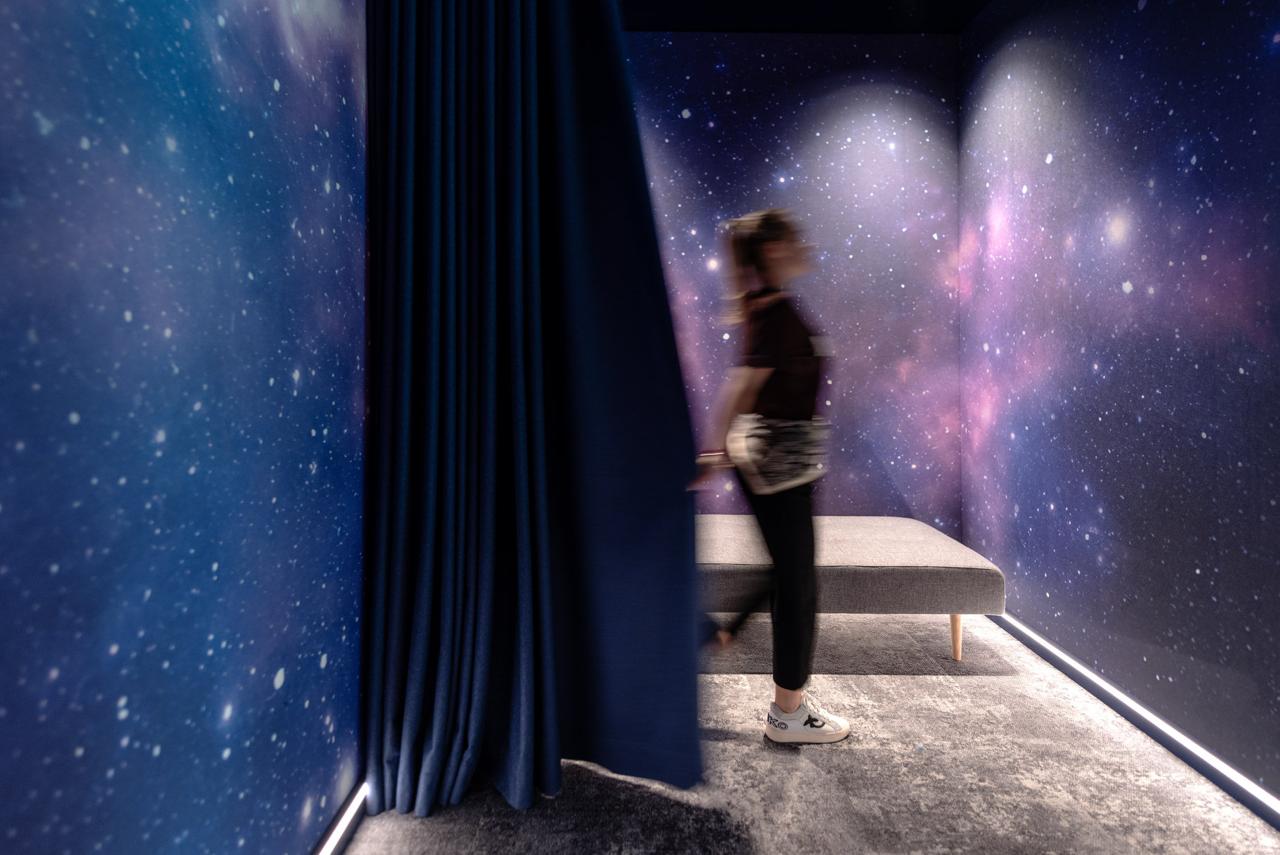
|
Nyquista Team
Research in environmental psychology and soundscape science clearly shows that sound is one of the strongest factors affecting stress levels, concentration, and the ability to rest. Importantly, it is not only about whether it is loud, but about how the space sounds.
Silence is not everything - what does rest sound like?
Intuitively, it might seem that the ideal relaxation zone is one in which absolute silence prevails. Meanwhile, the human brain was not designed to function in an environment completely devoid of sounds. In such conditions, it often remains in a state of alertness - “listening out” for something unexpected. From a biological perspective, absolute silence can be unnatural, and even unsettling.
Contemporary research on the “indoor soundscape” shows that three elements are key to relaxation: noise control, short reverberation time, and the presence of gentle, predictable background sounds. These are precisely what make a space perceived as safe and conducive to recovery, rather than empty and disturbing.
An interesting paradox is that we often describe rooms as “too loud,” even when sound level measurements indicate low values. The source of discomfort is then not noise, but long reverberation, which causes sounds to “linger” in space and overlap. The brain perceives this as acoustic chaos, even if it is not intense.
Sound insulation - silence begins at the boundaries.
Designing the acoustics of a chillout room is worth starting with the question: where can sound reach us from? Acoustic insulation is not a feature of a single element, but of the entire partition system, which includes walls, doors, windows, as well as the connections between them.
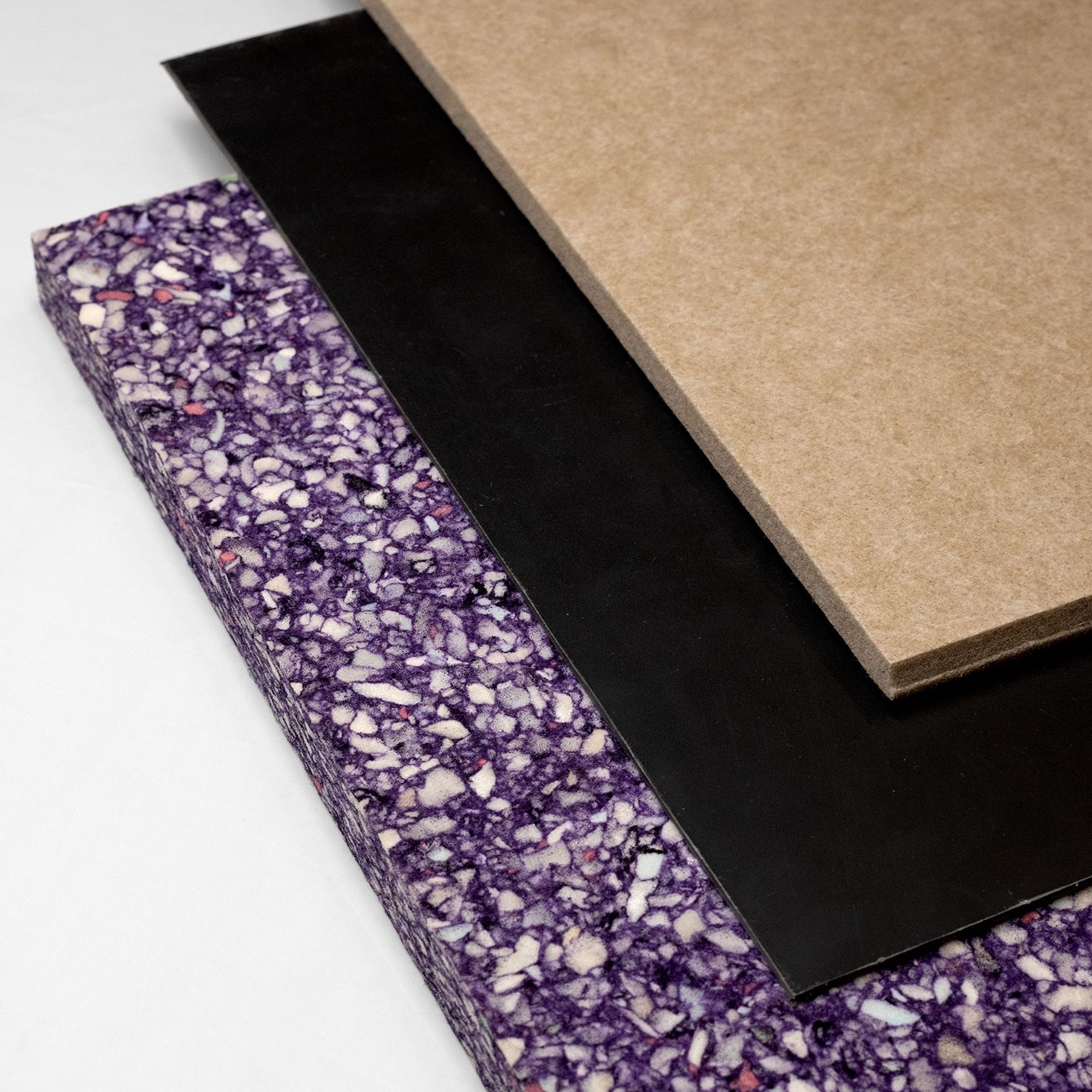
in the photo: insulation system SilenceMat
Walls usually constitute the largest partition surface, and that is why they often receive the most attention. Their effectiveness in attenuating sound depends on mass, airtightness, and layered construction. “Mass–spring–mass” systems, in which two material layers are separated by a space filled, for example, with mineral wool, make it possible to significantly reduce the transmission of speech sounds and background noise.
However, even the best-designed wall will not fulfill its role if the remaining elements do not match its insulation performance. Sound always chooses the weakest path – and that is very often doors or windows.
Doors and windows - details that determine success or failure.
Doors to the relaxation zone should be treated as a full-fledged element of the acoustic partition, not merely as a functional detail. Their acoustic insulation must be selected deliberately, already at the design stage. Lightweight door leaves, missing seals, or leaks around the frame cause conversation sounds and outside noise to penetrate the interior easily.
It is similar with windows. If the chillout room has contact with external or semi-public space, it is necessary to use windows with appropriate acoustic insulation. What is crucial here is not only the material itself, but also correct installation – even the best window will not perform its function if the seals are poorly installed or damaged.
In practice, this means that acoustics cannot be “added” at the end of a project. Insulation must be planned from the very beginning, because later corrections are costly and often less effective.

Ventilation - essential, but requiring control.
Another element of the insulation system is ventilation. A chillout room must provide comfortable air conditions, but at the same time it cannot become a source of constant hiss or hum. Sounds generated by ventilation systems, especially low-frequency ones, are particularly burdensome for the nervous system because they are difficult to “switch off” in perception.
That is why, in relaxation zones, it is so important to use acoustic silencers, low air-flow velocities, and separation of the room from loud technical equipment. This is another argument for taking acoustic issues into account already at the design concept stage.
Acoustic treatment - shaping the sound of the interior.
While insulation provides protection from sounds coming from outside, acoustic treatment is responsible for how the interior itself sounds. Its main goal is to control reverberation time so that sounds decay quickly and do not overlap.
The most commonly used sound-absorbing materials are mineral wool, PET panels, and textile elements. Increasingly often, however, designers also reach for mobile solutions that allow the space to be shaped flexibly. Acoustic screens, totems, or freestanding panels not only improve acoustic conditions, but also enable subtle zoning without the need to build permanent walls.
Such solutions work especially well in larger chillout rooms or multifunctional spaces, where the interior layout may change depending on needs.
Sound masking - when silence needs support.
Even the best acoustically treated interior may seem acoustically too “empty.” In such cases, sound masking proves helpful, i.e., introducing a delicate background that stabilizes the soundscape.
The most effective here are nature sounds, especially the sound of water. An increasingly popular solution is water walls over which a thin layer of water flows. They simultaneously serve several functions: they generate a pleasant, broadband masking sound, improve the interior microclimate, and have a visually calming effect.
The sound of flowing water is irregular but predictable, so the brain does not interpret it as a threat. Instead, it allows other background sounds, such as distant conversations or installation noise, to be “blurred.”
The chillout room as a coherent soundscape.
A well-designed relaxation zone is not the effect of a single measure, but of a coherent strategy in which insulation, treatment, and masking complement one another. Walls, doors, and windows create a tight barrier against noise. Absorbing materials and mobile solutions organize the interior acoustics. Natural background sounds give the space a friendly, restorative character.
A chillout room designed in this way is not simply quiet. It is acoustically understandable to humans - and this is exactly the kind of space that truly supports rest.


See also


Office / Showroom
Production / Warehouse
Let's do something together
Use the form - we will respond as soon as possible!