|
Nyquista Team
Fortunately, improving home acoustics does not require a major renovation—just a few simple and inexpensive tricks are enough to create optimal conditions for your child’s development.
Why does noise bother your child more than it bothers you?
A child’s brain works differently from an adult’s brain. The ability to filter speech from background noise, known as the cocktail party effect, fully develops only during the teenage years. This means that sounds that are merely background for you may be an insurmountable barrier for your child.
A child needs silence to understand: For a child to understand speech, it must be much louder than surrounding sounds (even by +15 dB). For an adult, a small advantage is enough (about +6 dB) [Iglehart 2020].
Reverberation is tiring and distracting: In empty, minimalist rooms with hard flooring, sound bounces off the walls for a long time, creating reverberation. This phenomenon causes words to blend together, forcing the child to make a huge effort to understand text read aloud or an instruction.
How to create the ideal study space in 5 steps?
You do not have to invest in a professional recording studio. A few strategic changes are enough for your child’s room acoustics to start supporting learning instead of making it harder.
Place the desk in a strategic location: Preferably away from the door and from a wall adjacent to the kitchen or living room. Avoid placing it in the center of the room, where sounds come from every direction.
Add soft surfaces: This is the simplest and most effective way to fight reverberation. Thick curtains, a rug, soft cushions, or plush toys act as natural sound absorbers.
Fill shelves with books: Shelves full of books with irregular surfaces are excellent at diffusing sound waves, reducing unpleasant echo in the room.
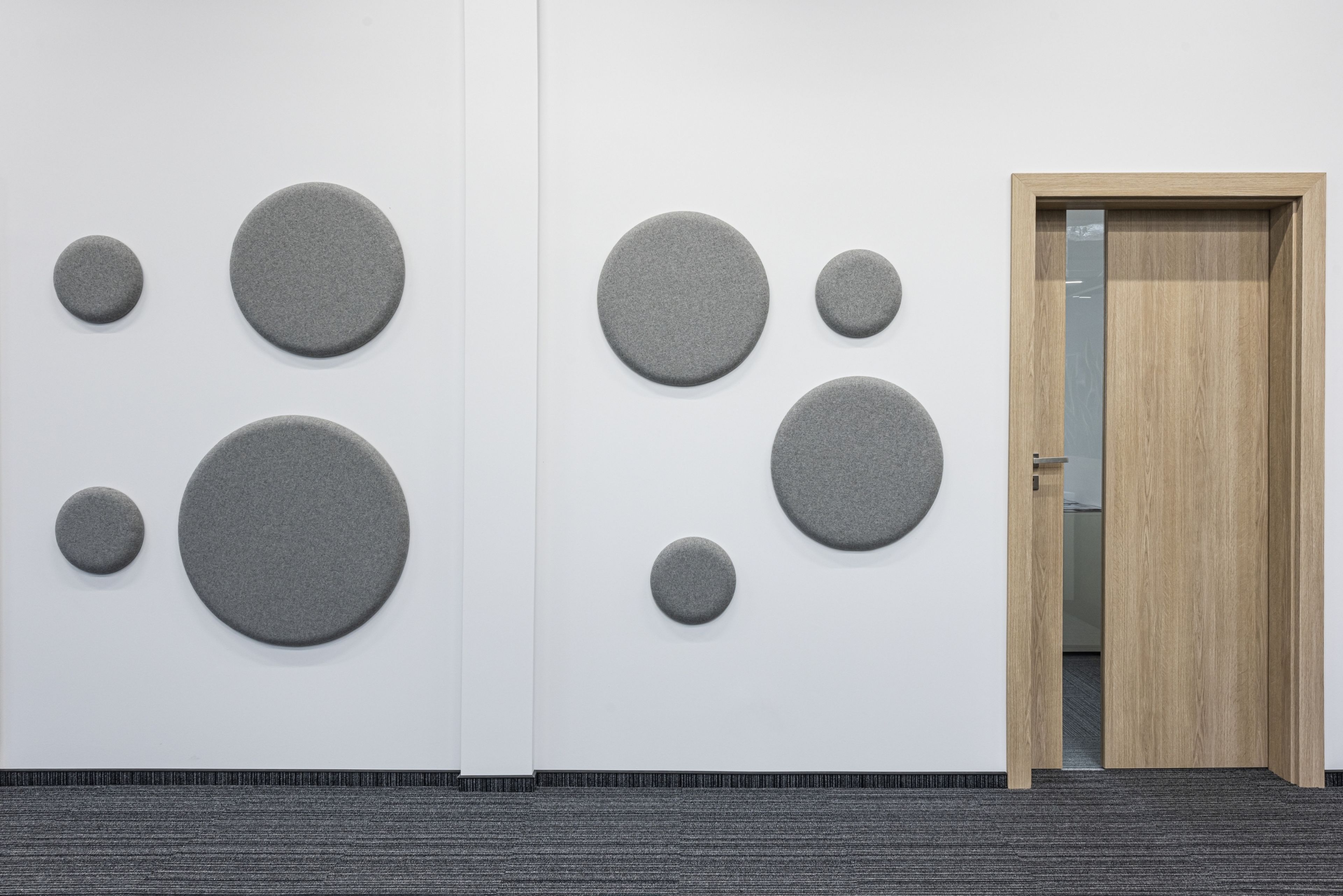
Invest in simple solutions: There are aesthetic acoustic panels (e.g., made of PET felt) available on the market that can be hung on the wall as decoration. Door seals, which limit noise coming from the hallway, can be just as effective.
Set household quiet rules: Agree that during homework time you do not turn on the washing machine, vacuum cleaner, or loud music. These devices generate noise at a level of 50–70 dB, which effectively prevents concentration.
White noise and noise-canceling headphones—help or trap?
In the search for silence, parents often turn to modern technology. However, it is worth using it consciously.
White noise: Although it may help children with ADHD concentrate, in neurotypical children it often has the opposite effect—it adds another distracting stimulus and masks important sounds. It is not a universal solution.
Headphones with active noise cancellation (ANC): They are an excellent tool for short-term, intensive work in a noisy environment (e.g., when siblings are playing nearby). However, they should not be a permanent part of studying. They mainly reduce steady, low-frequency noise, and continuous use isolates the child from their surroundings and can be tiring. Treat them as support, not a primary solution.
The best gift you can give your child at the start of a new school year is peace and quiet. By investing in good acoustics in your home space, you invest in their concentration, better learning outcomes, and overall well-being.
Scientific sources:
American Speech-Language-Hearing Association (ASHA). (2024). Classroom Acoustics. Retrieved from https://www.asha.org
ANSI/ASA. (2010). ANSI/ASA S12.60-2010: Acoustical Performance Criteria, Design Requirements, and Guidelines for Schools. Acoustical Society of America.
Crandell, C. C., & Smaldino, J. J. (2000). Classroom acoustics for children with normal hearing and with hearing impairment. Language, Speech, and Hearing Services in Schools, 31(4), 362–370.
Iglehart, F. (2020). Effects of reverberation and signal-to-noise ratio on speech recognition and listening effort in school-age children. Journal of Educational Audiology.
Klatte, M., Lachmann, T., & Meis, M. (2010). Effects of noise and reverberation on speech perception and listening comprehension of children and adults in a classroom-like setting. Noise & Health, 12(49), 270–282.
Leibold, L. J., Buss, E., & Calandruccio, L. (2021). Developmental effects in masked speech recognition. Journal of the Acoustical Society of America, 149(2), 1171–1185.
PN-B-02151-2:2018-01. (2018). Building acoustics – Protection against noise in buildings – Part 2: Requirements for permissible sound levels in rooms. Polish Committee for Standardization.
Shield, B., & Dockrell, J. (2008). The effects of environmental and classroom noise on the academic attainments of primary school children. Journal of the Acoustical Society of America, 123(1), 133–144.
Söderlund, G. B. W., Sikström, S., & Smart, A. (2007). Listen to the noise: Noise is beneficial for cognitive performance in ADHD. Journal of Child Psychology and Psychiatry, 48(8), 840–847.
World Health Organization (WHO). (2009). Night Noise Guidelines for Europe. Copenhagen: WHO Regional Office for Europe.
World Health Organization (WHO). (2018). Environmental Noise Guidelines for the European Region. Copenhagen: WHO Regional Office for Europe.

See also


Office / Showroom
Production / Warehouse
Let's do something together
Use the form - we will respond as soon as possible!