Acoustic services

Acoustic services

Acoustic services

Auralization

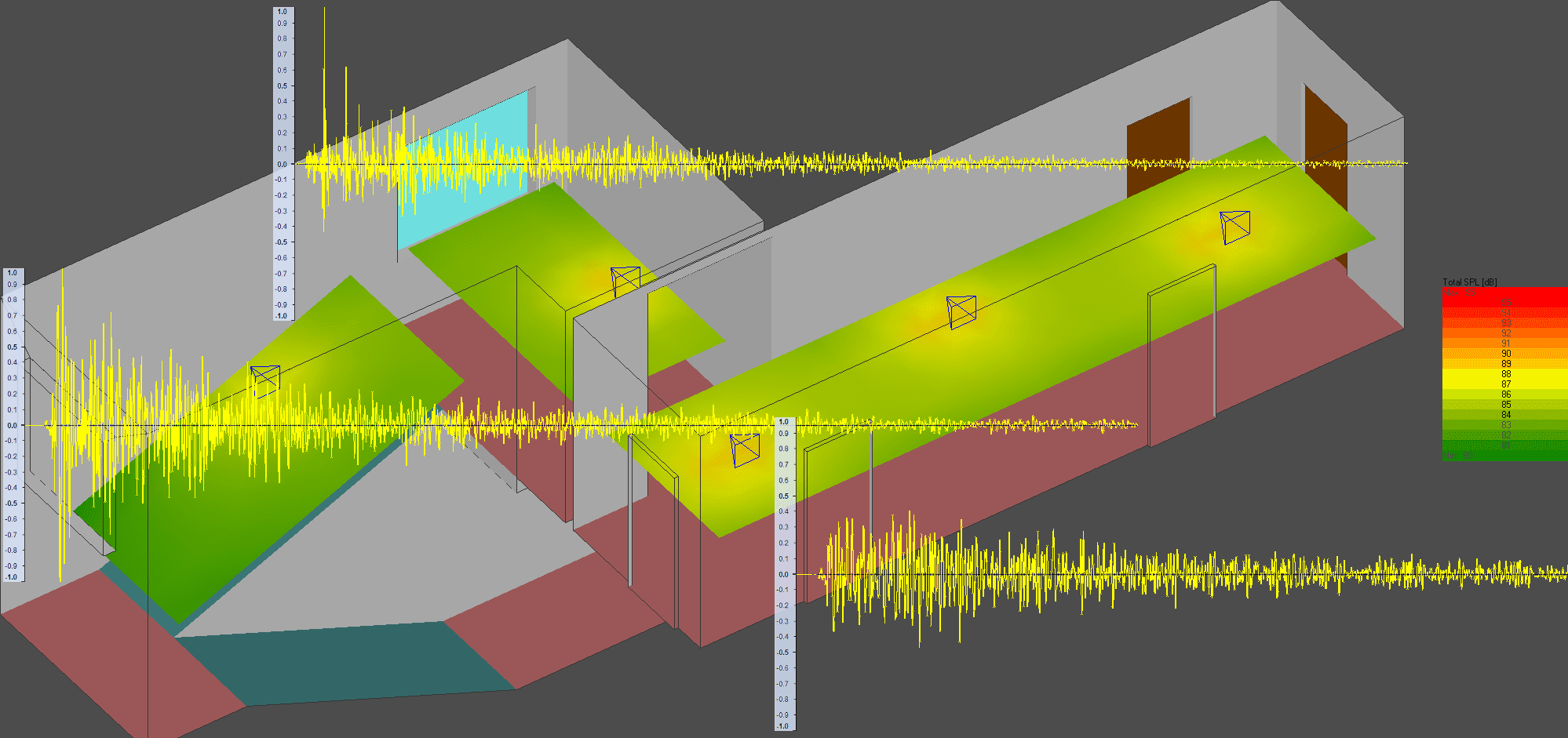
Auralization is an advanced method of presenting the results of acoustic simulations, which allows one to hear how a room will sound even before it is realized. By using data from reverberation simulations, we create a realistic audio recording that captures the acoustics of the designed space — from subtle reflections to full, natural sounds of the interior. This way, one can not only see the results of the simulations but also experience them auditorily, which provides exceptional support in the design process and decision-making.

Hear the acoustics before the space is created

Auralization is an advanced method of presenting the results of acoustic simulations that allows you to hear how the room will sound even before its realization.

Using data from reverberation simulations, we create a realistic audio recording capturing the acoustics of the designed space — from subtle reflections to full, natural sound of the interior.

This allows one not only to see the results of the simulation but also to experience them auditorily, providing exceptional support in the design and decision-making process.

How does auralization work?

Auralization is a direct extension of acoustic simulations.

In practice, it involves a digital signal processing operation, where the source signal (e.g., speech or music) is convolved with the room's impulse response, which has been generated based on a 3D computational model.

The impulse response describes how sound propagates, reflects, and decays in a given space. By combining it with the audio signal, a realistic recording is created, allowing for listening to the acoustics of a specific room or comparing several variants of its finishing.

Why is it worth using auralization?

Auralization not only has demonstrative value but, above all, analytical and design value.

With it, one can:

  • compare the impact of different materials and acoustic treatments on the sound of the room,

  • assess speech intelligibility, reverberation, and the sense of spaciousness,

  • check how changes in geometry or interior equipment affect sound,

  • present simulation results to a client in the form of an intuitive listening experience, rather than just visualizing the data.

To a limited extent, auralization can also relate to sound insulation, showing differences in sound transmission between rooms, but its main application area remains reverberation simulations.

How to listen to auralizations?

To fully appreciate the realism of sound and the spaciousness of the audio, we recommend listening to auralizations with headphones.

Thanks to the separation of channels and the lack of impact from the acoustics of the listening room, you can faithfully perceive the differences between project variants — hear how reverberation, speech clarity, or the sense of depth changes.

This way, auralization becomes not just an engineering tool but also an auditory experience that allows for an intuitive understanding of how acoustics influence the perception of sound.

This modern tool allows designers, architects, and investors to "hear the project" before it becomes a reality.

Talk to our expert

Sara Kopeć

Acoustic and vibroacoustic specialist

A specialist with extensive experience in building acoustics, environmental acoustics, and the design of spaces with high acoustic requirements, including listening rooms, cinemas, and recording studios. A PhD student at the AGH University of Science and Technology in Krakow, where she conducts research on modern solutions based on metamaterials. She combines a practical design approach with expert knowledge and scientific curiosity, implementing projects that encompass the full spectrum of acoustic and vibroacoustic issues.

Talk to our expert

Sara Kopeć

Acoustic and vibroacoustic specialist

A specialist with extensive experience in building acoustics, environmental acoustics, and the design of spaces with high acoustic requirements, including listening rooms, cinemas, and recording studios. A PhD student at the AGH University of Science and Technology in Krakow, where she conducts research on modern solutions based on metamaterials. She combines a practical design approach with expert knowledge and scientific curiosity, implementing projects that encompass the full spectrum of acoustic and vibroacoustic issues.

Talk to our expert

Sara Kopeć

Acoustic and vibroacoustic specialist

A specialist with extensive experience in building acoustics, environmental acoustics, and the design of spaces with high acoustic requirements, including listening rooms, cinemas, and recording studios. A PhD student at the AGH University of Science and Technology in Krakow, where she conducts research on modern solutions based on metamaterials. She combines a practical design approach with expert knowledge and scientific curiosity, implementing projects that encompass the full spectrum of acoustic and vibroacoustic issues.

Follow us on Instagram