
How do we hear? The function of the hearing organ
|
Nyquist Team
How many songs have you listened to today? How many conversations have you had? And have you ever wondered how it happens that we hear? How does what someone says reach us? To answer this, we should start with what sound is.
How many songs have you listened to today? How many conversations have you had? Have you ever wondered how it happens that we hear? How does what someone says to us reach us? To answer this, we need to start with what sound is.
From this text, you will learn:
What does the auditory organ look like?
Which ear processes music better?
Why do our ears get clogged when flying in an airplane?
How do we hear? The auditory organ.
Sound is produced by a propagating acoustic wave, which is the vibration of particles in the air. Although this happens incredibly quickly, when sound reaches our auditory organ - the ear - it still has a long way to travel before we "hear" it.
What is the ear made of?
Our ear can be divided into three parts: the outer ear, the middle ear, and the inner ear.
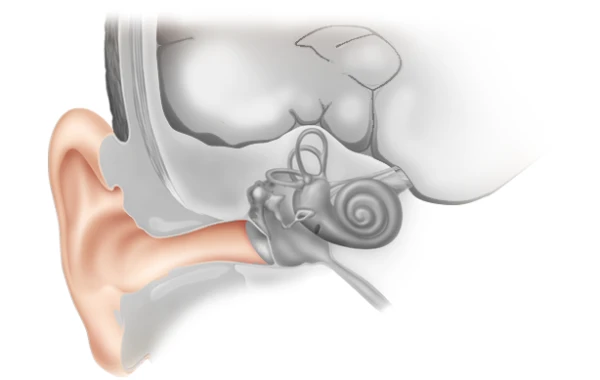
The outer ear includes the auricle, the ear canal, and the eardrum. Each of us has a unique shape of the auricle; it is as unique as a fingerprint. We can say that it captures sounds from the surrounding environment, and thanks to having two ears and two auricles, we have the ability to spatially locate sound sources (you can read more about localization in this article). Then, vibrations travel through the ear canal to the eardrum, causing it to vibrate. The membrane is directly connected to the tympanic cavity - the first element of the middle ear.
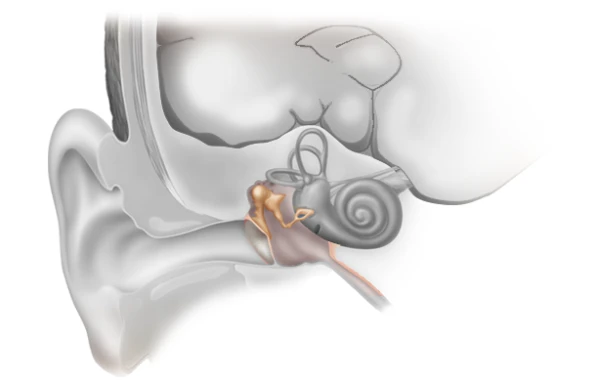
Now we are in the middle ear - what will we find here? First and foremost, the tympanic cavity, three ossicles, and the Eustachian tube.
The tympanic cavity is an air space separated from the outside by the eardrum. From there, vibrations are transmitted to a set of three ossicles: the malleus, the incus, and the stapes. It is here, in the middle ear, that the smallest bones in our body are located. What are they for? They amplify the received vibrations by as much as twenty times! They then forward them to the inner ear.
We have already discussed the tympanic cavity and ossicles. What do we need the Eustachian tube for in the ear? It connects the ear to the throat, and its task is to equalize the pressure between that outside and that in our body. Have you ever flown in an airplane and had your ears pop while climbing or descending? That's exactly when the Eustachian tube "unclogs" them again. The last major element of the auditory organ is the inner ear, which consists of the vestibular system and the cochlea.
The vestibular system - in collaboration with the eyes, nerves, and brain - is responsible for regulating balance in the body. The cochlea, which receives the amplified vibrations (or rather the fluid contained in the cochlea), converts them into nerve impulses. Thanks to the connection with the auditory nerve, the impulses from the cochlea can reach the central nervous system.
Now straight to the temporal lobe, where they are processed into auditory perception, and we finally "hear". As you can see, the process of hearing is quite extraordinary, and every element of the structure of the auditory organ affects it. Even the number of ears matters because although they are built the same, studies have shown that the right ear processes speech better, while the left processes music. Additionally, we hear with a delay because the brain needs about 10-15 milliseconds to receive and process sound, and for lower frequencies, this time can extend to 0.1 seconds.

See also

Follow us on Instagram
Office / Showroom
Production / Warehouse
Let's do something together
Use the form - we will respond as soon as possible!