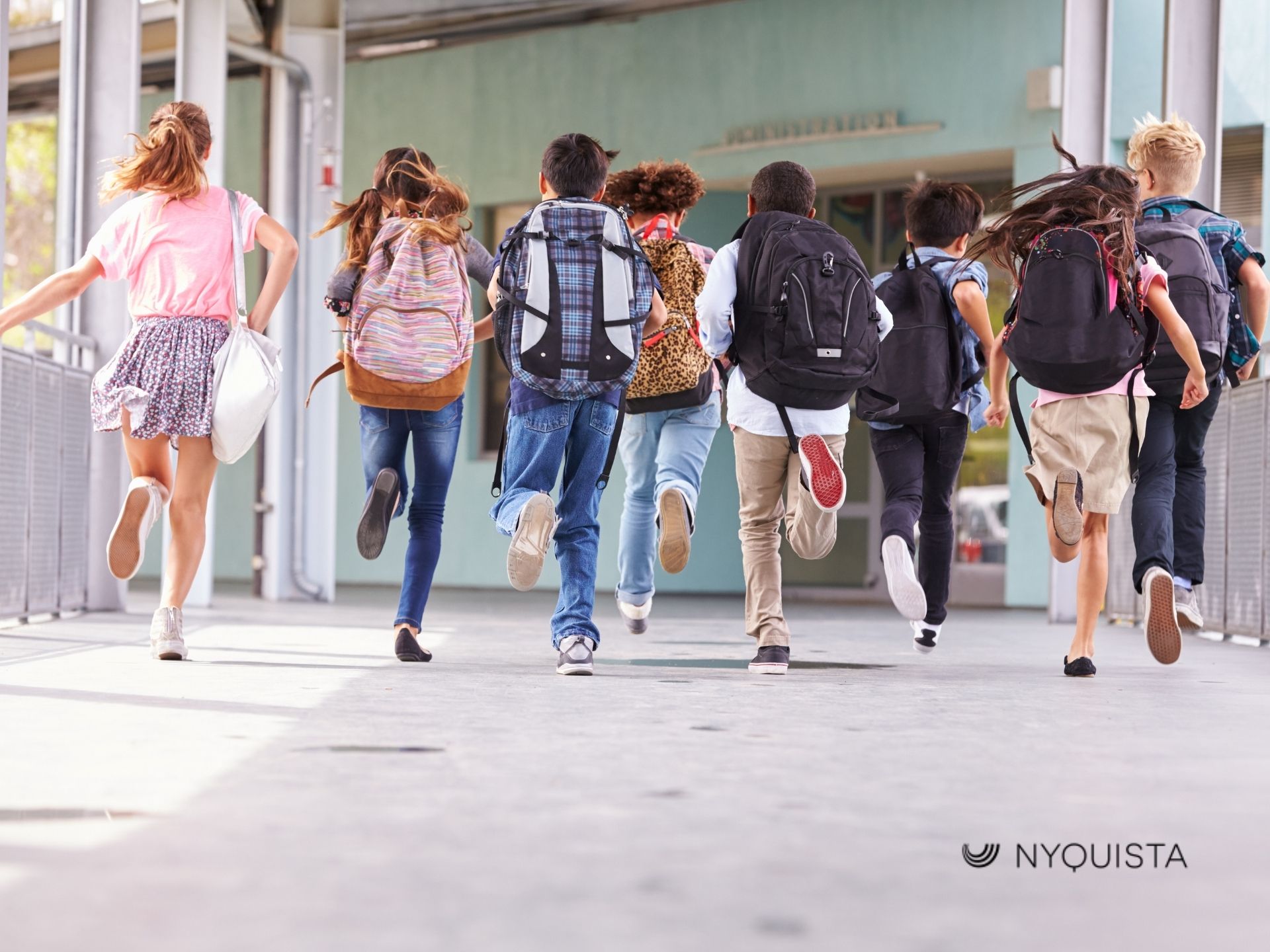
Noise in Polish schools exceeds the norms by twice. How does it damage your child's health and academic performance?
|
Nyquist Team
Noise in Polish schools exceeds permissible levels by even double, creating an environment that seriously harms the educational process and the health of students and teachers. Research by the National Institute of Hygiene and the Central Institute for Labor Protection shows that the average sound level in classrooms during lessons reaches 72 dB, while the legal limit (PN-B-02151-2:2018-01) sets the boundary at 35 dB.
This level of noise, comparable to the bustle of a busy street, leads to deterioration in academic performance, concentration problems, and increased stress levels, and for teachers, it results in chronic occupational voice disorders.
The effects of noise on students: Poorer results and concentration problems
Excessive noise in the classroom is not just discomfort – it is a real barrier to gaining knowledge. Numerous scientific studies confirm that:
Students achieve poorer results in native language and mathematics tests (Shield & Dockrell, 2003). In conditions of noise above 65 dB, concentration significantly decreases and the number of mistakes increases.
Children with disorders such as dyslexia, speech impairments, or hearing loss suffer the most. They need clear speech signals, which is impossible in a noisy classroom (Crandell & Smaldino, 2000).
Chronic exposure to noise causes increased stress levels, sleep problems, and poorer retention of material (Hygge et al., 2002).
An additional problem is the too long reverberation time, which in many Polish schools is 1.0–1.5 seconds, while the norm allows a maximum of 0.6 seconds. This causes sounds to overlap and makes the teacher's speech incomprehensible.
Teachers' health at stake: Voice disorders and burnout
Teachers, trying to outshout the school noise, pay for it with their health. This phenomenon, known as the Lombard effect, leads to serious consequences:
Voice disorders are one of the most common occupational illnesses in this group. As many as 65% of teachers experience voice problems during their careers (Smith et al., 1997).
Noise is a powerful stressor. It raises cortisol levels, and according to surveys, even 80% of Polish teachers identify it as one of the main sources of daily psychological burden.
How to fight noise in schools? Effective and proven solutions
The problem of noise in schools can be effectively solved. The key is to improve the acoustics of the rooms. Installing drop ceilings and wall panels can reduce reverberation time by half and increase speech intelligibility by as much as 35%.
Inspirations also come from other countries:
Finland: Leads educational programs teaching children the culture of silence and reducing unnecessary noise.
Norway: Designs schools using sound-absorbing materials and implements visual noise indicators – lights that turn on when it gets too loud in the classroom.
USA: Uses hearing assistance systems, where the teacher speaks into a microphone, and their voice is evenly distributed through speakers in the room.
United Kingdom: Has introduced regular and transparent acoustic audits in schools, which become the basis for decisions on building modernization.
Noise in schools is not a problem that can be ignored. It poses a real threat to the quality of Polish education. Implementing proven acoustic and educational solutions is an investment in a better future for students and healthier working conditions for teachers.
Scientific sources:
Shield, B., & Dockrell, J. (2003). The effects of noise on children at school: A review. Building Acoustics, 10(2), 97–116.
Crandell, C., & Smaldino, J. (2000). Classroom acoustics for children with normal hearing and with hearing impairment. Language, Speech, and Hearing Services in Schools, 31(4), 362–370.
Hygge, S., Evans, G. W., & Bullinger, M. (2002). A prospective study of some effects of aircraft noise on cognitive performance in schoolchildren. Psychological Science, 13(5), 469–474.
Smith, E., Gray, S. D., Dove, H., Kirchner, L., & Heras, H. (1997). Frequency and effects of teachers’ voice problems. Journal of Voice, 11(1), 81–87.
Persson Waye, K. (2011). Effects of classroom acoustics on children's perception of speech and learning. Journal of the Acoustical Society of America, 130(4), 2354.
Maxwell, L., & Evans, G. (2000). The effects of noise on pre-school children’s pre-reading skills. Journal of Environmental Psychology, 20(1), 91–97.

See also

Follow us on Instagram
Office / Showroom
Production / Warehouse
Let's do something together
Use the form - we will respond as soon as possible!