
Wavelength of acoustic wave (λ)
|
Nyquist Team
Why can a quiet conversation be easily stopped by a thin partition, while the bass from the neighbor's party penetrates through concrete ceilings as if it were not there at all? Why does a high-frequency speaker fit in the palm of your hand, while a subwoofer takes up half the trunk? The answer lies in the physical dimensions of sound – because sound literally has its size.
Professional Definition
In wave physics, the wavelength is the spatial equivalent of the period of oscillation. It is one of the most important quantities used to describe wave motion.
Wavelength of Sound (λ) – the distance between two successive points in a medium where the acoustic oscillations at that moment have the same phase and which is determined according to the direction of wave propagation.
In engineering practice, the wavelength is closely related to the frequency (f) and the speed of sound (c) and is expressed by the formula:
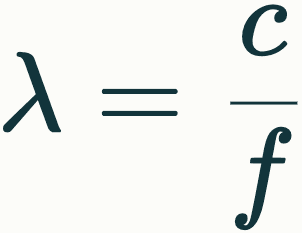
Where:
(λ) – wavelength in meters [m],
c – speed of sound (in air about 340 m/s),
f – frequency in hertz [Hz].
Acoustics in Simple Words
The simplest way to imagine it is through waves in the sea. The wavelength is simply the distance from the crest of one wave to the crest of the next. In acoustics, it is the same – it is the distance in the air between one maximum density of particles and the next.
What is fascinating about acoustics is the enormous range of these sizes. Sound behaves quite differently depending on how "long" it is.
Let’s apply the formula in practice, assuming the speed of sound is 340 m/s:
High tones (e.g., mosquito buzz - 10,000 Hz):
The wave has a length of just 3.4 centimeters. It is short, "fine". Such a wave easily reflects off small objects (e.g., a cup on a table) and can be stopped even by a thin glass.Medium tones (e.g., human speech - 500 Hz):
The wave has a length of 68 centimeters. This is already a specific dimension comparable to the width of a person's shoulders.Low tones (e.g., powerful bass - 20 Hz):
This is where things get tricky. A wave with a frequency of 20 Hz has a length of as much as 17 meters! That’s the height of a multi-story building.
What does this mean in practice?
That’s why bass sounds are so hard to soundproof. A wave that is several meters long does not "notice" a thin drywall partition – it simply flows around it or penetrates through it, causing the entire structure to vibrate. Understanding wavelength is crucial when designing insulation and acoustic adaptation – you cannot "catch" a 17-meter wave with a piece of thin sponge.
Summary
The wavelength of sound (λ) is the physical size of one complete cycle of oscillation in space. It is inversely proportional to frequency: the higher the sound, the shorter the wave; the lower the bass, the longer the wave. Understanding this scale (from centimeters to several meters) helps in understanding why different sounds behave so differently in rooms.

See also
Follow us on Instagram
Office / Showroom
Production / Warehouse
Let's do something together
Use the form - we will respond as soon as possible!