
What is the sound volume level? More than just decibels.
|
Nyquist Team
Have you ever listened to music very quietly and felt that the bass disappeared? Or wondered why alarms and sirens have such an irritating, shrill tone? The answer lies not only in the physics of sound waves but primarily in how our brain interprets this wave.
Today we will delve into the topic of sound pressure level – a concept that connects hard physical data with subjective human perception.
Physics of Sound: Energy and Pressure
Before we get to what we hear, we must understand what actually reaches our ears. Sound is a mechanical wave that carries energy.
The two basic physical quantities that describe the "power" of sound are:
Acoustic Pressure: These are small variations in the static pressure of air (i.e., atmospheric pressure) caused by the propagation of a sound wave.
Acoustic Intensity: This defines the amount of energy that a sound wave carries per unit time through a unit area. This quantity is defined perpendicular to the direction of the wave’s propagation. This means that intensity carries information about the amount of energy and its direction - it is a vector quantity.
In practice, we rarely use raw values of intensity (in watts per square meter) or pressure (in pascals), because for human hearing, differences in loudness are not perceived linearly but logarithmically. For this reason, using linear values would be misleading and would not convey the actual acoustic impression. Therefore, we use a logarithmic scale and a unit called decibel (dB), which allows us to describe these differences in a way consistent with sound perception.
Phenomenon | Sound Pressure Level Lₚ [dB] | Acoustic Pressure p [Pa] |
Rustling leaves (very quiet) | approx. 20 dB | approx. 0.0002 Pa (2×10⁻⁴ Pa) |
Starting jet plane | approx. 130 dB | approx. 63 Pa |
As seen in the table, there is a difference of more than a million times in the values of acoustic pressure between rustling leaves and a starting airplane, and in energetic terms – as much as a trillion times in sound intensity. However, thanks to the logarithmic scale, we can describe this range in simple numbers from 20 to 130 dB, which greatly facilitates the analysis and comparison of noise levels.
We then refer to the Sound Pressure Level (SPL), which is a value expressed in decibels (dB) that describes the changes in acoustic pressure measured by a microphone. This parameter allows for a quantitative analysis of sound. However, while the microphone records the physical values of pressure with great precision, it does not "hear" sound as humans do – it does not take into account subjective perception, ear sensitivity, or frequency dependence.
The Ear is not a Microphone: Subjective Perception of Loudness
Here we reach the crux of the matter. The energy delivered to the ear is one thing, and how loud the sound seems to us is another.
The human ear is an incredibly complex instrument that does not react linearly. Our hearing apparatus is unable to distinguish very fast, transient changes in sound intensity. In practice, our brain "averages" the received energy.
Most importantly, the perception of loudness depends not only on intensity but also on the frequency (pitch) of the sound.
Evolution has equipped us with "filters" that make us hear certain frequencies much better than others.
Frequency range 1 kHz – 5 kHz: This is the band to which we are most sensitive. Sounds in this range seem the loudest at the same level of energy. Why? This is due to the characteristics of the auditory system’s transmission (including the resonance of the ear canal and tympanic membrane). Furthermore, this range contains most of the critical information in human speech (e.g., consonants that determine the understanding of words) and warning sounds (such as a baby's cry).
Low and very high tones: To perceive a very low bass (e.g., 50 Hz) as loudly as a 1 kHz tone, that bass must have a much higher physical level (more decibels SPL).
So what is the Sound Level of Loudness?
To reconcile the world of physics (dB SPL) with the world of human sensations, the concept of sound level of loudness was introduced.
Sound level of loudness is a psychoacoustic measure that indicates how loud a person perceives a given sound in relation to a reference sound.
The unit of loudness level is phon.
How does it work? The phon scale has been "anchored" at a frequency of 1 kHz (1000 Hz).
For a sound at a frequency of 1 kHz, the loudness level in phons is numerically equal to the sound pressure level in decibels (dB SPL). That is: a 1 kHz tone with an acoustic pressure level of 60 dB has a loudness level of 60 phons.
For other frequencies, it is determined experimentally by asking people: "Is this bass as loud as our reference signal of 1 kHz?".
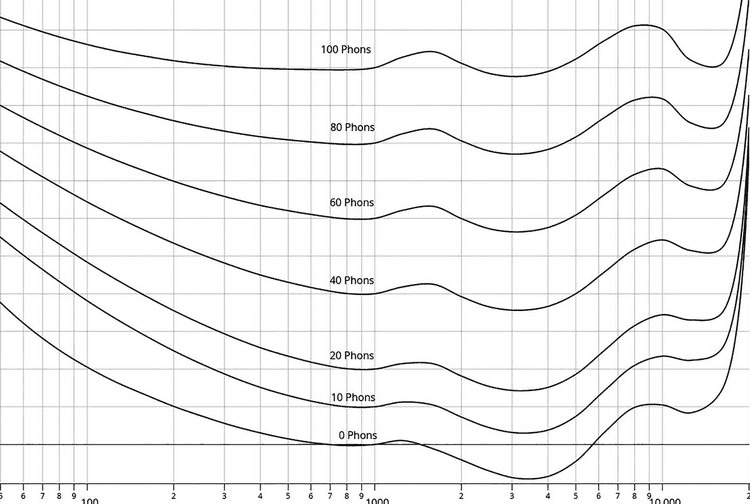
Equal Loudness Curves (Isochrones)
The results of such studies allowed the creation of the so-called isophonic curves (often referred to as Fletcher-Munson curves, although today we use newer ISO standards).
A curve with a value of e.g. 40 phons shows what sound pressure level (in dB SPL) must be present for a sound of any frequency to be perceived as equally loud as a 1 kHz tone at a level of 40 dB SPL. The graph clearly shows that at low loudness levels, the human ear is much less sensitive to low and high frequencies, which is why during quiet listening, bass and high tones seem weaker. For this reason, older amplifiers had a “Loudness” button that compensated for these differences by boosting the extremes of the frequency range at low volumes.
Summary
Understanding the difference between physical sound pressure level and perceived loudness level is crucial in many fields – from music production, through environmental protection (noise), to the design of alarm systems. Remember: what the meter shows in decibels is only part of the picture - the full impression of loudness arises only in our ear and brain.

See also

Follow us on Instagram
Office / Showroom
Production / Warehouse
Let's do something together
Use the form - we will respond as soon as possible!