What is reverberation time (RT60) and why is it crucial for sound quality?
|
Nyquist Team
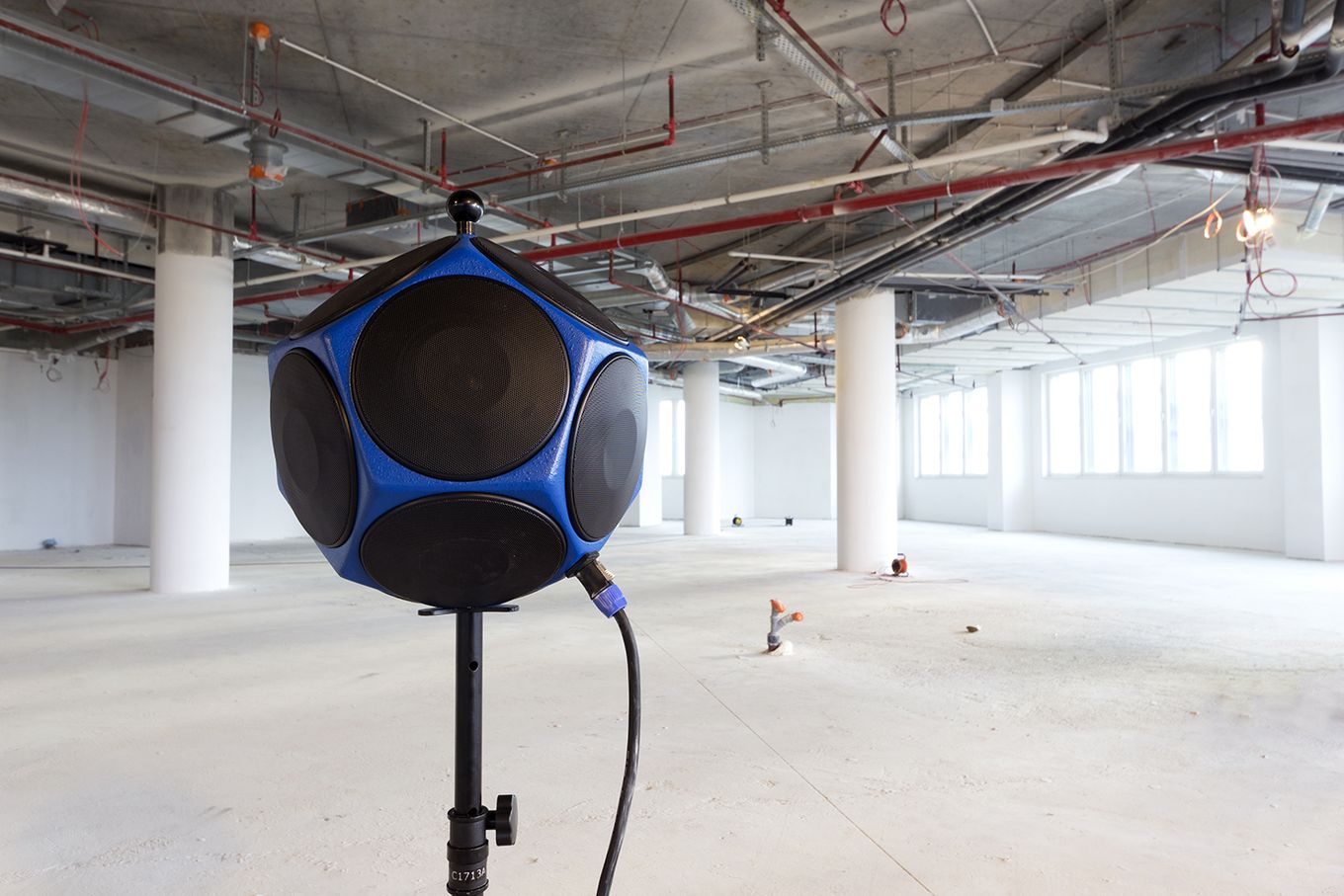
The basic parameter determining the acoustic conditions of a given interior is the reverberation time, measured in seconds. This is the time needed for the sound to fade away, counting from the moment it stops being emitted, that is, from the moment the source is turned off.
The term "sound drop" should be treated as a certain shorthand, which is precisely defined in theory and practice as a decrease in sound pressure level (from English SPL - Sound Pressure Level) of 60 dB. In practice, a range above 60 dB is often not possible to measure due to the level of background noise. In standard spaces where people are present, the mentioned background noise level will never be 0 dB. It usually ranges from 15 dB to as much as 30 dB (which is still perceived by humans as silence). To register the discussed decrease in sound pressure level of 60 dB, a level above 100 dB would need to be generated, which can be harmful to individuals present in the room. In such cases, measurements for a drop of 30 dB or 20 dB are made. The result of the reverberation time T30 or T20 is multiplied by two or three times, respectively, which constitutes an extrapolation to 60 dB.
Reverberation time varies depending on frequency.
Its nature affects many different aspects of the sound quality perceived by us and the comfort of staying in a given space. The functional use of the room determines which of these aspects are crucial. In the case of a listening room, limiting the reverberation time allows for a clear reception of music, as it was designed by the sound engineer. But can one go for extreme soundproofing in order to achieve high fidelity of the reproduced sound? One can, but such extremity, contrary to appearances, will not bring beneficial effects. The sound experiences in such a room will be unnatural, and the sound perceived as artificial, dead, empty, and limited to the space between the speakers. A significantly more beneficial solution is to manage acoustic energy in such a way as to create conditions for spatial sound, which can be defined as three-dimensional.
Descriptions of sound experiences are based on subjective perception of sound quality and can sometimes sound esoteric. However, there are objective parameters describing acoustic phenomena that we can relate to the impressions received through the sense of hearing. Moreover, we can shape these phenomena according to our needs.
It should be noted that reverberation parameters for different types of rooms are specified in legal regulations. Article 7 section 2 point 1 of the Act of July 7, 1994, Construction Law. (Journal of Laws 1994 No. 89 item 414) states that:
"The conditions mentioned in section 1 point 1 are determined, by way of regulation, by the minister responsible for construction, planning, spatial development, and housing for buildings and related devices..."
The regulations of the competent minister, mentioned above, specifying the technical conditions regarding acoustics for buildings as of the date of this document's publication, are the regulation of the Minister of Infrastructure of April 12, 2002, on the technical conditions that buildings and their location should meet, and the regulation of the Minister of Infrastructure and Construction of November 14, 2017, amending the regulation on the technical conditions that buildings and their location should meet. The first of them contains the following provision (Chapter IX, §323):
"Rooms in residential buildings, collective living spaces, and public utility buildings must be protected from noise:
external, penetrating into the room from outside the building,
coming from the installation of devices constituting the technical equipment of the building,
airborne and impact noises produced by users of other apartments, commercial premises, or rooms with different usage requirements,
reverberation, arising from the reflection of sound waves from partitions limiting a given room."
The parameter describing the specified point of the mentioned regulation (Chapter IX, §323) is precisely the reverberation time.
This parameter is the foundation of room acoustics, which directly translates into how we perceive music, speech, and the overall acoustic comfort. However, the optimal reverberation time is just the beginning of the adventure in acoustic design.

See also
Office / Showroom
Production / Warehouse
Let's do something together
Use the form - we will respond as soon as possible!