
Sound reflection coefficient (energy) (β)
|
Nyquist Team
When a sound wave hits a wall, an invisible division of energy occurs: part disappears into the material, while part returns to the room. It is this returning fragment that determines whether there will be reverberation or silence in the room. Learn about the parameter that defines the acoustic 'mirrors'.
Professional Definition
The sound reflection coefficient (β) is the ratio of the energy of the acoustic wave reflected from a given surface to the energy of the acoustic wave incident on that surface.
In physical terms, this is a dimensionless quantity taking values from 0 to 1. A value of β = 1 means total reflection of energy (an ideally hard, smooth surface), while β = 0 means no reflection (total absorption or transmission of sound). In the energy balance, this coefficient is the complement of the absorption coefficient (α) and the transmission coefficient (τ), according to the principle of energy conservation.
Acoustics in Simple Words
Think of throwing a tennis ball at various obstacles. If you throw it at a concrete wall, the ball will bounce back to you at almost the same speed – this is a high reflection coefficient (close to 1). However, if you throw the ball at an open window or a thick pile of cushions, the ball may not return at all or will return very weakly. In acoustics, concrete, glass, and tiles are the walls that "bounce the balls" (sound), creating an echo, while mineral wool or sponges are materials that absorb those balls, reducing reflection.
Summary
The sound reflection coefficient (β) is crucial in designing the shape of concert halls and selecting finishing materials. It determines how much acoustic energy remains in the room, directly affecting the reverberation time and speech intelligibility.

See also

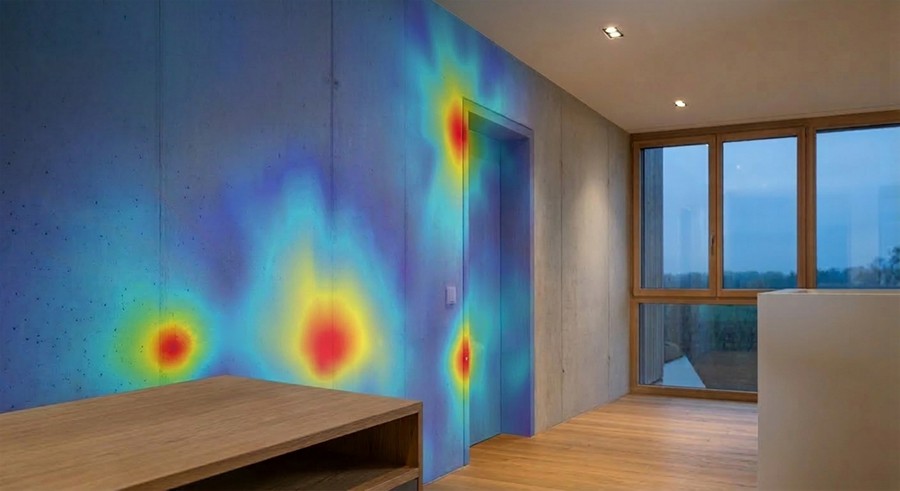

Office / Showroom
Production / Warehouse
Let's do something together
Use the form - we will respond as soon as possible!