
Sound-absorbing material
|
Nyquist Team
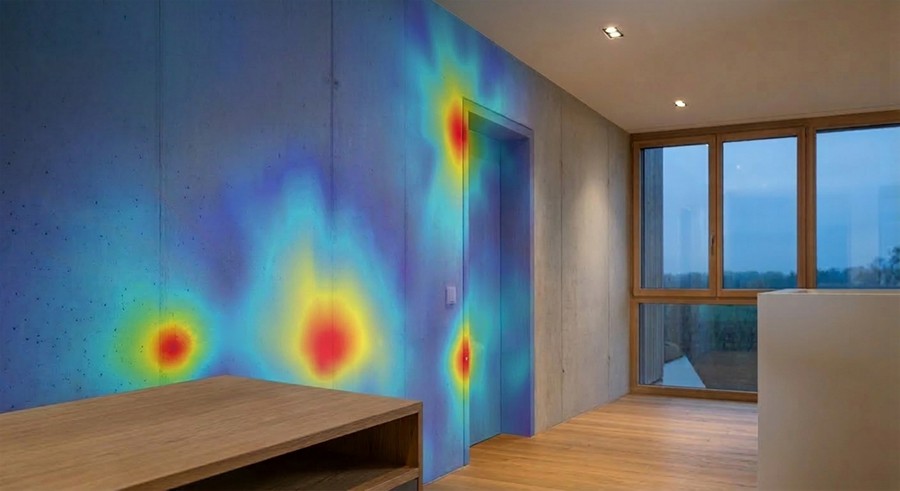
Have you ever wondered why in an empty apartment every word sounds loud and sharp, while after placing furniture and carpets it becomes pleasantly quiet? This is due to the physics of sound absorption. Sound-absorbing materials are the foundation of any acoustic adaptation, used to tame unruly reflections of sound waves.
Professional Definition
Sound-absorbing material is a physical entity characterized by a high sound absorption coefficient (α), whose structure – usually porous, fibrous, or granular – allows effective dissipation of acoustic wave energy. This process involves the irreversible conversion of the mechanical energy of vibrating air molecules into thermal energy due to viscous and frictional phenomena within the material's pores.
In engineering practice, the effectiveness of such materials is rated on a scale from 0 (total reflection, e.g., an ideal acoustic mirror) to 1 (total absorption, e.g., a hole in the wall). Among the most popular materials of this type are mineral wool, open-cell polyurethane foams, acoustic felts, and specialized sinters. A key parameter here is air flow resistance – the material cannot be too dense (as it will act like a wall), nor too sparse (as the sound will pass through it without loss).
Acoustics in Simple Words
To understand how sound-absorbing material works, imagine the difference between throwing a tennis ball at a concrete wall and throwing it into dense bushes or a pile of pillows. The concrete wall is a hard (reflective) material – the ball comes back to you with almost the same energy. This is echo in a raw room.
Sound-absorbing material acts like those bushes or a sponge. The sound wave “enters” its structure and must squeeze through millions of microscopic corridors. This requires effort. During this “squeezing,” air molecules collide with the walls of the material, losing their speed and energy (converting it into trace amounts of heat). As a result, the sound gets “trapped” and dampened instead of returning to the room and making noise.
Summary
Sound-absorbing materials are essential for controlling reverberation time in rooms. They are not used for isolating noise coming from neighbors (for that, mass and tightness are required), but for “cleaning” the sound inside the room, making speech clearer and noise less tiring.

See also

Office / Showroom
Production / Warehouse
Let's do something together
Use the form - we will respond as soon as possible!