
Node
|
Nyquist Team
Have you ever wondered why in some places of the room the bass seems to disappear, even though the speakers are working at full capacity? It's not magic, but the physics of standing waves. The key to understanding this phenomenon is the points of rest, called nodes.
Professional Definition
A node is a point, line, or surface in a standing wave field, at which the magnitude characterizing acoustic vibrations reaches a minimum.
In room acoustics, we most often analyze nodes of acoustic pressure and nodes of particle velocity. It is important to remember that in a standing wave, these two phenomena are out of phase – where there is a pressure node (silence), we often encounter a velocity arrow (maximum particle motion). The location of nodes is crucial in acoustic adaptation, determining among other things the optimal listening position.
Acoustics in Simple Words
Imagine two people swinging a long jump rope. The middle of the rope spins with great amplitude (this is the so-called arrow), but right at the hands of the people holding the rope, the movement is minimal or none at all. These nearly motionless points are the nodes. The same happens with sound reflecting off the walls in your room. If you stand at the node of a given frequency (e.g., low bass), you might feel as if someone suddenly turned off the subwoofer, even though the same sound is deafening in another part of the room.
Summary
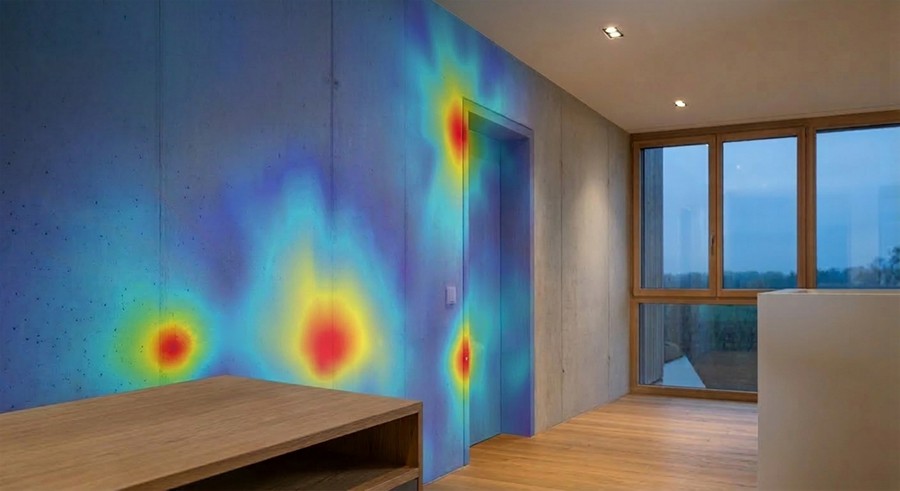
A node is a location in the space encompassed by a standing wave where the amplitude of vibrations drops to a minimum (theoretically to zero). Its opposite is the arrow. A map of nodes and arrows in a room allows for the prediction of the distribution of eigenmodes (resonances).

See also


Office / Showroom
Production / Warehouse
Let's do something together
Use the form - we will respond as soon as possible!