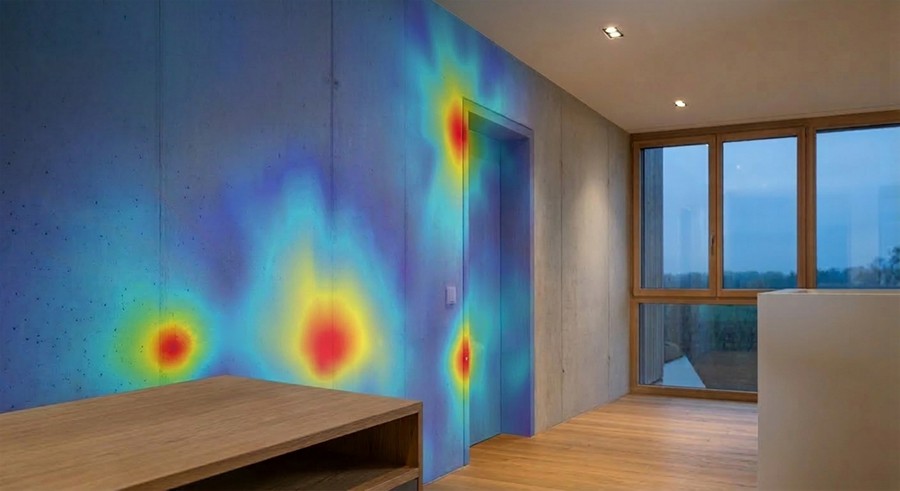
Discussion of measurement results step by step
|
Nyquist Team
The measurement, conducted with a sound intensity probe, collects a considerable amount of raw measurement data, which is practically useless for documentation and further interpretation by humans. Therefore, there is a need for a relatively advanced processing of this data to obtain a clear and unambiguous picture of the acoustic insulation defects of the tested object – walls, doors, windows, or their connections.
Ways of Processing
The signal of sound intensity registered by the probe is transformed according to Fourier's formulas. This procedure allows the representation of the signal in the form of a frequency plot. In other words, in addition to obtaining the received resultant "loudness" (sound intensity level), we can extract how much acoustic energy is contained within the interesting frequency range from about 200 Hz to 20 kHz. As a result of this stage, after recording the signal, we have a time trace of the sound intensity level for each point above the studied partition as well as its frequency characteristics.
The processing of raw data from the probe for further interpretation is performed by an acoustics specialist using specialized software that has the aforementioned methods of processing.
Values and Their Interpretation
The sound intensity value recorded by the probe (presented in dB) means that, unlike audible acoustic pressure (also in dB), it provides much more acoustic information regarding what we are able to hear. This is primarily about a significantly larger signal-to-noise ratio in the range of mid and high frequencies, as well as obtaining information regarding the direction (vector) of the sound wave propagation.
And what is the practical significance of these mentioned advantages? They allow very precise localization of the sound leak (i.e., the acoustic bridge), even when we cannot hear it due to the low audible level of acoustic pressure. This means identifying acoustic bridges in structural terms, not just based on their audibility or lack thereof. By applying frequency filtering, we can indicate a specific range that this identified bridge "passes through," or, based on the known frequency of a potential noise source, we can determine exactly whether the sounds are coming solely from it or if we are dealing with another factor disturbing the silence.
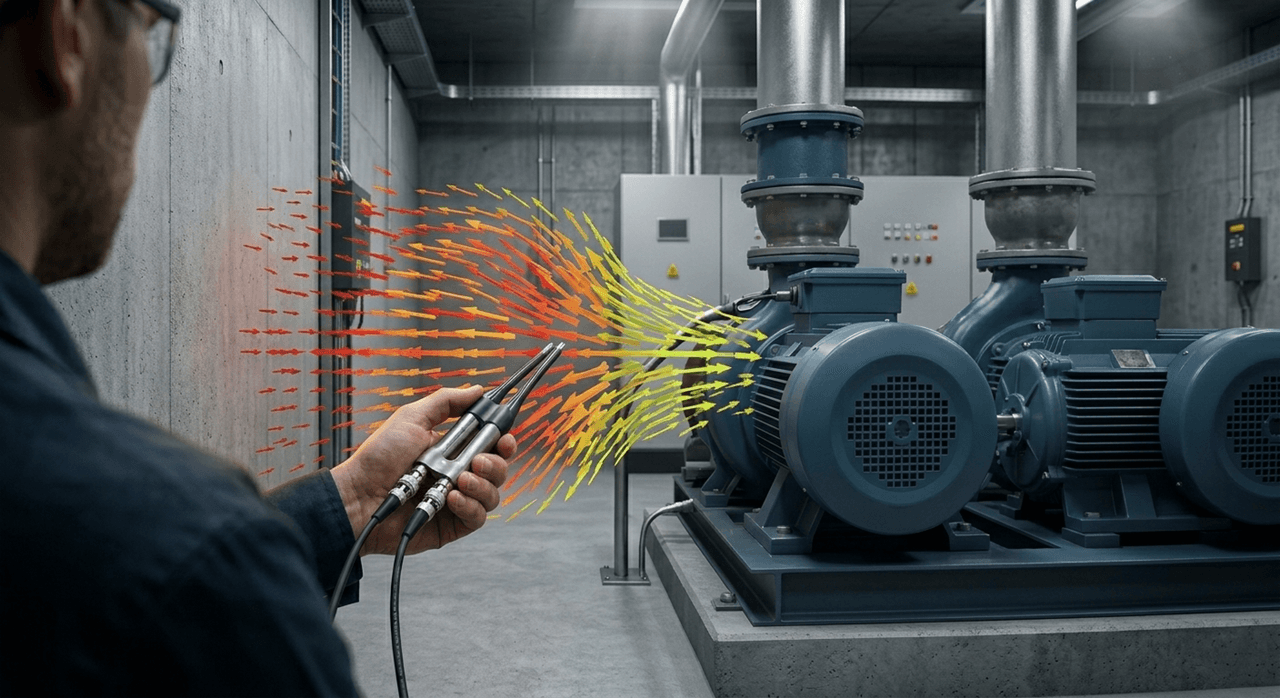
On the other hand, during analysis, there is the possibility to cut off all other sounds not originating strictly from the studied surface and even from the point at which the probe is currently located. These are "non-excludable" background sounds, including ambient noise and reverberation enhancements by the room. This property leads to the ability to determine the acoustic power along with establishing the direction of sound emission directly. And this is essential for measuring the actual power from production machines and devices, such as air conditioning systems, as well as for vector mapping of the acoustic field generated by speakers. Of course, along with detailing the spectral components of the sound.
Conclusions and Measures
Based on these prepared noise distribution maps using specialized software, we can infer whether the problem of poor insulation, e.g., doors, will be resolved after their replacement, replacing the gasket, threshold, or if it will be sufficient to simply adjust or level those doors in a specific place. The same applies to windows and glass partitions.
The obtained noise map of the internal partition wall will indicate the location of thinning of the wall, made, for example, by a neighbor who carved grooves for hydraulic pipes directly into the wall. It will also enable us to identify gaps in the wall or at its junctions, such as with the ceiling.
Based on the assessment of the partition's permeability and a comparison with other partitions within the room, we can determine which of them carries the most noise, and increase acoustic insulation precisely for the weakest of them.

See also
Office / Showroom
Production / Warehouse
Let's do something together
Use the form - we will respond as soon as possible!