
Direct transfer
|
Nyquist Team
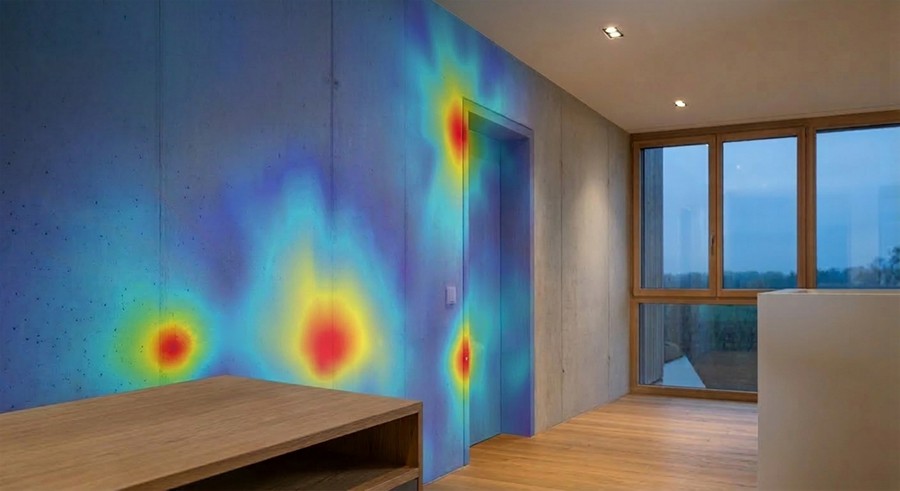
When you hear your neighbor through the wall, you instinctively think that the sound is penetrating straight through the wall separating your apartments. Although in building physics sound seeks many escape routes, this shortest path is often the most obvious one. Direct transmission is the foundation from which we start the fight for silence.
Professional Definition
This is a method of transmitting acoustic energy, in which sound travels from the transmitting room to the receiving room solely through the element separating these rooms (e.g., a partition wall or ceiling), without the involvement of side paths. The sound insulation value for direct transmission mainly depends on the surface mass of the partition, its stiffness, and airtightness.
“In the computational model of acoustic insulation, direct transmission is the dominant component only when lateral (flanking) transmission is minimized.”
Acoustics in Simple Words
Imagine a dam on a river. The water that seeps through cracks in the dam wall itself is analogous to direct transmission. The water that flows around the dam, soaking into the ground at the edges, is lateral transmission. If you want to seal the dam (soundproof a room), the first step is to patch the holes in the wall itself. However, if the wall is solid and water continues to flow, you need to address the edges. In acoustics, if the wall is as thin as paper, then direct transmission accounts for 90% of the noise you hear.
Summary
Direct transmission concerns the shortest path of sound through the separating partition. Its limitation is the first and most important step in acoustic insulation, usually achieved by increasing the wall mass or using multilayer structures.

See also


Office / Showroom
Production / Warehouse
Let's do something together
Use the form - we will respond as soon as possible!